
Newsletter #445
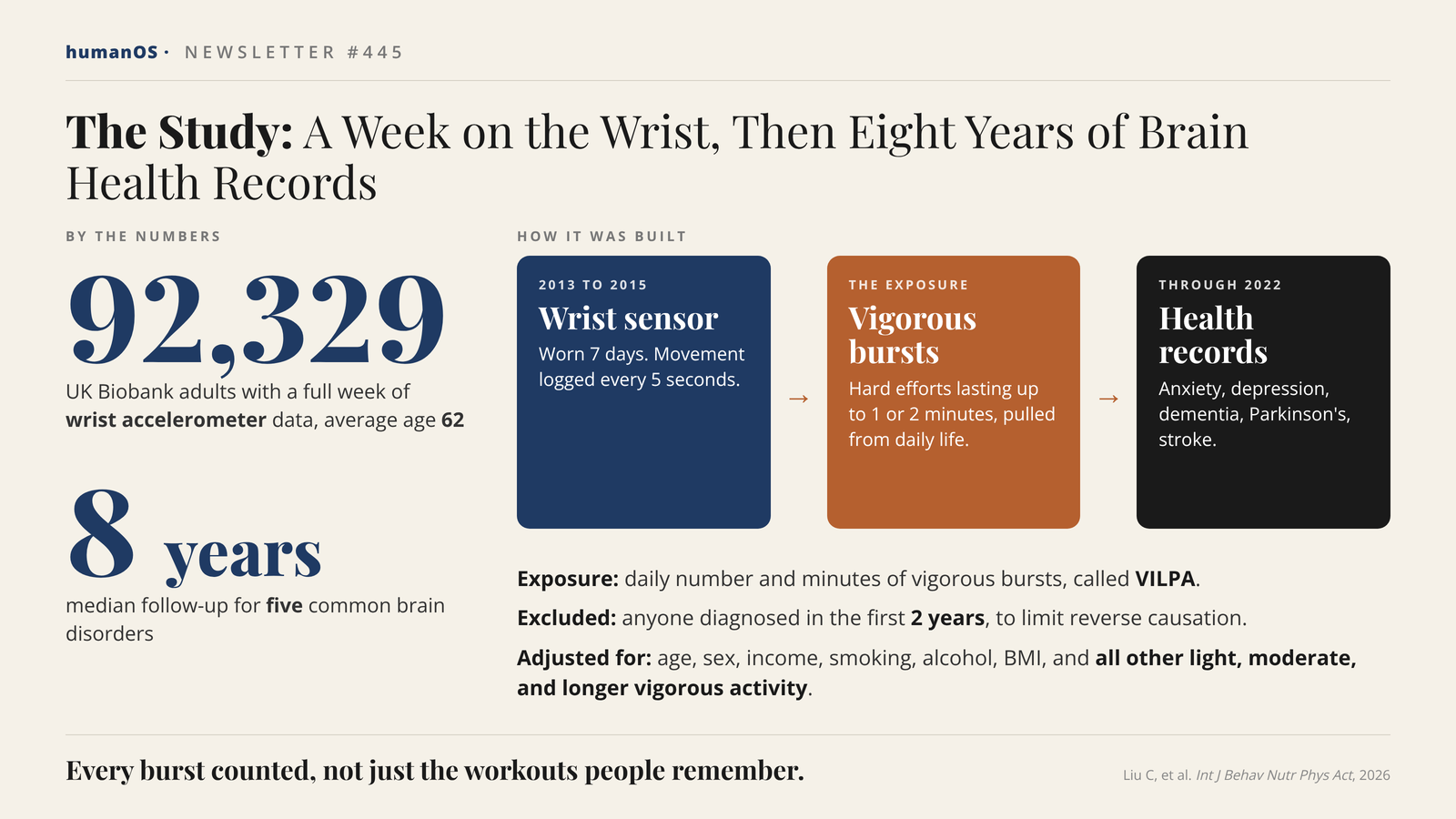
A few one-minute bursts of hard effort each day were linked to a lower risk of dementia, anxiety, depression, and Parkinson's disease. That's the finding from a new study of about 92,000 adults in the UK who wore activity trackers for a week and were followed for about eight years. The biggest drop in risk came from the first couple of bursts. It showed up in people who exercised and in people who didn't. This is the same pattern InTUNE training (which I created here on humanOS.me) was built around. Let's take a closer look.
If these newsletters are a regular part of how you stay informed on health and longevity, consider supporting the work with a Pro membership. $19.99 per quarter, about $1.67 per issue, less than a coffee tip.
Join here: Become a Member
Review Your Learnings: Newsletter Summaries ✨
Micro-bursts matter: vigorous intermittent lifestyle physical activity and risk of common brain disorders in a prospective cohort study
What is vigorous intermittent lifestyle physical activity?
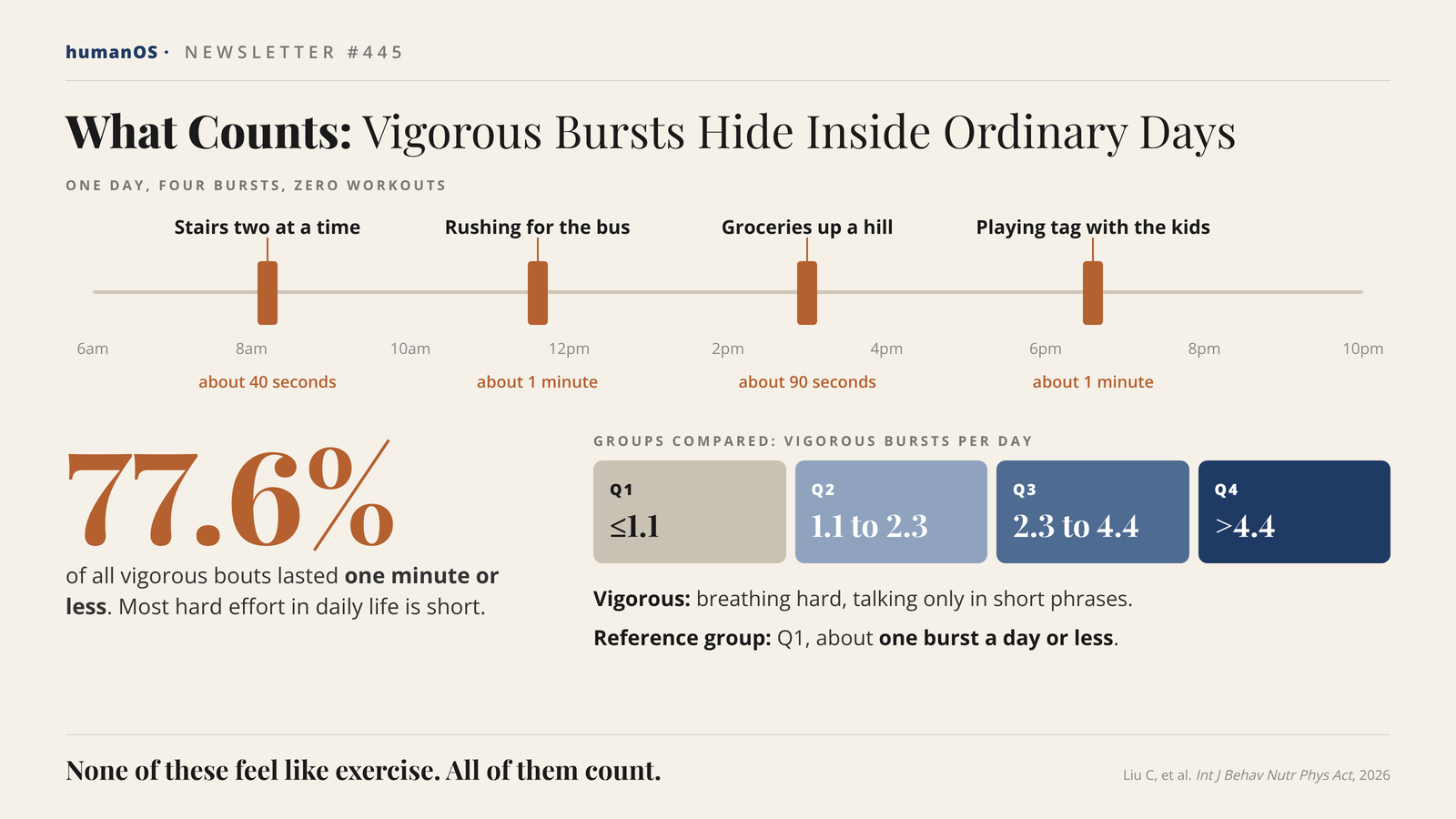
Vigorous intermittent lifestyle physical activity, or VILPA, is short bursts of hard effort that happen during normal daily life. Taking the stairs two at a time. Hustling to catch a bus. Carrying heavy groceries up a hill. Playing tag with your kids. Each burst lasts a minute or two, and none of it counts as a workout, but they matter.
Surveys miss these moments. Ask people how much they exercise and they'll describe their runs and gym sessions, not the 40 seconds they spent charging up a flight of stairs. A wrist accelerometer, a motion sensor worn like a watch, picks up all of it.
The researchers used data from the UK Biobank. Between 2013 and 2015, about 92,000 adults with an average age of 62 wore an accelerometer for a week. The team pulled out every bout of vigorous movement that lasted up to one minute, and up to two minutes. Then they tracked who developed five common brain disorders over about eight years. These were anxiety, depression, dementia, Parkinson's disease, and stroke.
Most hard effort in daily life is short. More than three-quarters of all vigorous bouts lasted a minute or less.
How much did a few bursts lower brain disorder risk?
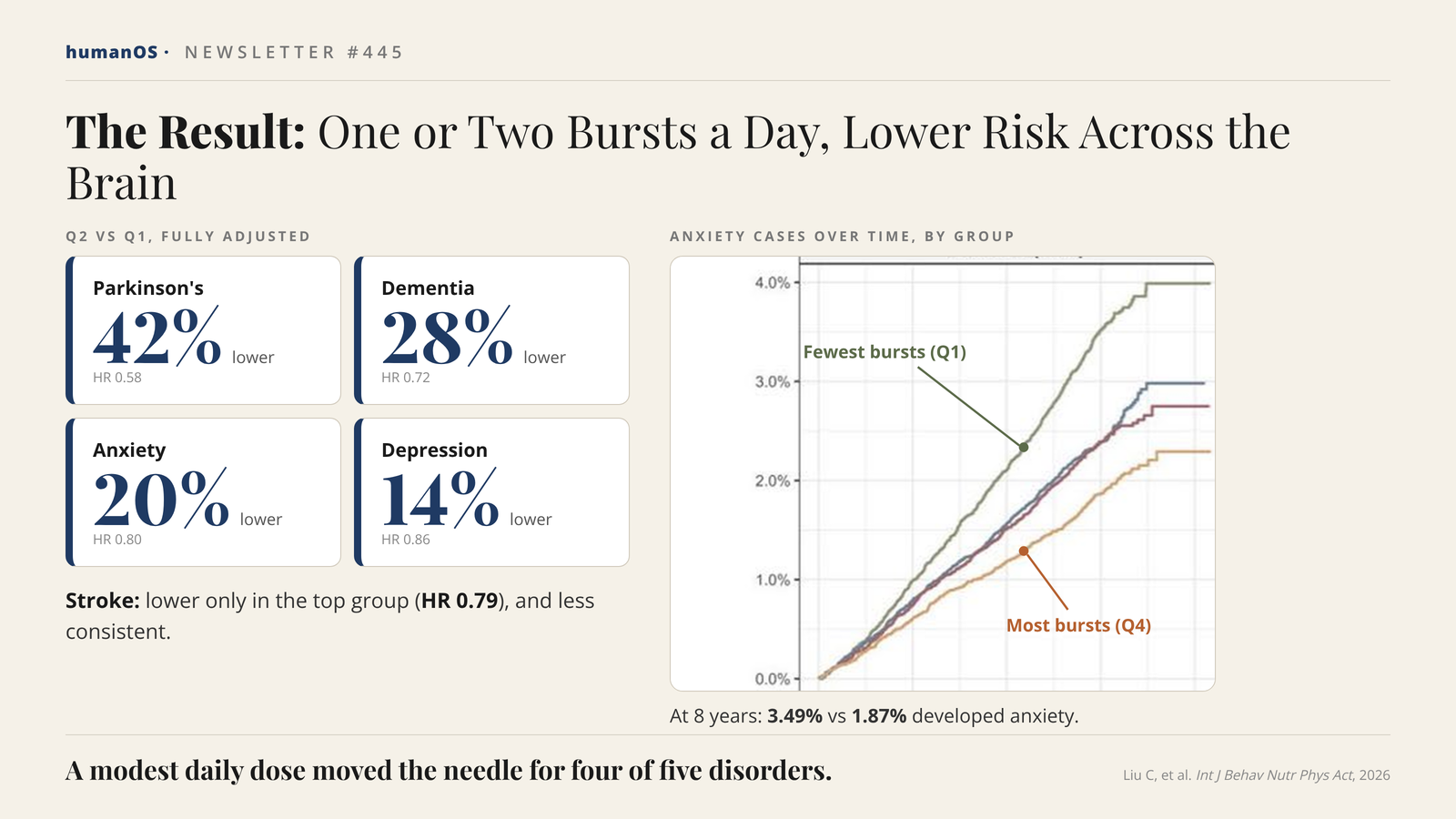
Even a modest amount of VILPA was linked to lower risk for four of the five disorders. Compared with people who had the fewest bursts, people averaging roughly one to two bursts a day had lower risk across the board.
Outcome | Risk with one to two bursts a day |
Parkinson's disease | About 42% lower |
Dementia | About 28% lower |
Anxiety | About 20% lower |
Depression | About 14% lower |
Stroke | Lower only at the highest levels, and less consistent |
These results accounted for age, sex, income, education, smoking, alcohol, and body weight. They also accounted for each person's light activity, moderate activity, and longer bouts of vigorous exercise. So the short bursts were linked to lower risk on top of everything else a person did.
The gap grew over time. By the eight-year mark, people with the fewest bursts had developed anxiety at nearly twice the rate of people with the most.
Why do the first few bursts matter most?
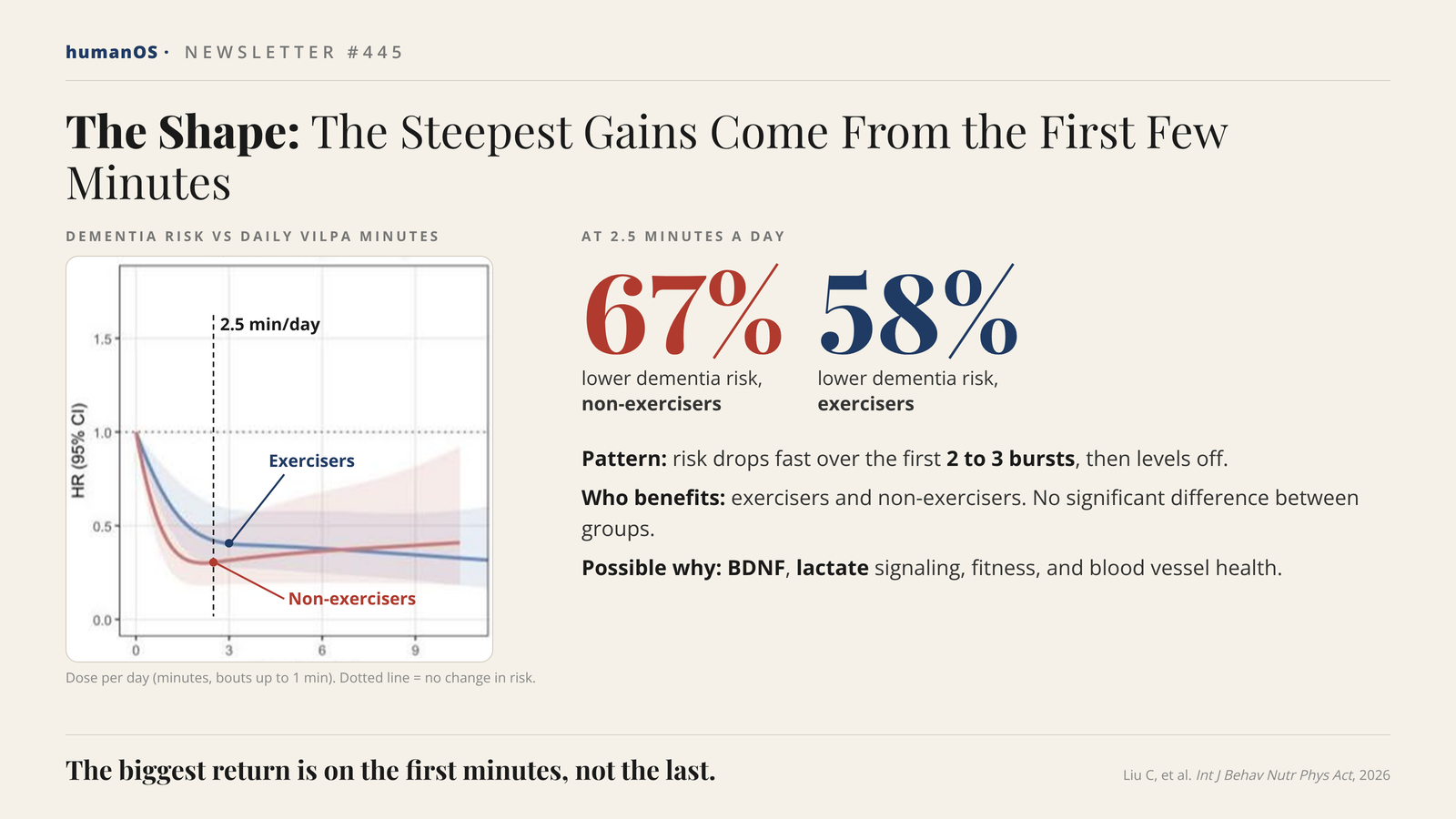
The biggest gains came at the very bottom of the curve. Risk fell steeply over the first couple of bursts a day, then leveled off. For anxiety, most of the drop happened between zero and about two bursts a day.
This held for exercisers and non-exercisers. Non-exercisers were people who did no sports or leisure exercise and walked for pleasure once a week or less. Among them, about two and a half minutes of daily VILPA was linked to a 67% lower risk of dementia. Among exercisers, the same amount was linked to a 58% lower risk.
How could a minute of effort reach the brain? The authors point to the same pathways that make high-intensity interval training (HIIT) good for the brain. Brief, hard efforts raise brain-derived neurotrophic factor (BDNF), a protein that helps neurons grow and connect. They push lactate into the blood, which the brain uses as both fuel and a signal to adapt. Over time, repeated bursts may also improve cardiorespiratory fitness, blood vessel function, and inflammation. Each of these protects the brain with age. We covered how exercise intensity shapes brainpower and BDNF in an earlier issue.
There are limits. This is an observational study, so it shows a link, not proof of cause. Activity was measured for one week. People in the early stages of a brain disorder may move less, which could make bursts look more protective than they are. The authors reduced this by leaving out anyone diagnosed in the first two years. Participants were mostly White, middle-aged and older, and healthier than average. A statistical check suggested an unmeasured factor would need to be fairly strong to explain the results away.
InTUNE Puts the Bursts on Purpose
VILPA happens by accident. InTUNE makes it happen on purpose.
InTUNE training is the humanOS workout program I built during my PhD. The name stands for integrative and opportunistic training. Each day has one workout made up of a few movements with rep number or time goals, about the size of a seven-minute workout. You have from the moment you wake up until bedtime to finish it. You can do it all at once, or break it into small exercise snacks spread through the day. Find more about it here.
That second option is the point of the study. A set of fast squats before your morning coffee. Push-ups while the kettle boils. Two flights of stairs at a hard pace before lunch. Burpees between meetings. Each takes about a minute. Done with real effort, until your breathing is heavy and talking gets hard, each one is the kind of vigorous burst this study tracked.
This study speaks to two kinds of people.
If you're mostly sedentary, this is the best news in the paper. The steepest part of the curve is at the start. Going from zero bursts to two or three a day is where risk dropped most. You don't need a gym, a schedule, or a 45-minute block of free time. You need a few minutes, spread out, and the willingness to push hard for each one. InTUNE gives you the movements and a daily target, so the first step is already planned. Small daily wins also make the habit easier to keep and easier to build on.
If you already exercise, bursts still add something. The study adjusted for other moderate and vigorous activity, and exercisers still showed lower risk with more VILPA. A morning workout covers one hour of the day. It doesn't cover the other fifteen you're awake. Long stretches of sitting carry their own costs, even for people who train. We looked at how much vigorous activity it takes to offset sitting in an earlier issue. InTUNE fills those hours with short, hard efforts, so movement becomes part of the whole day instead of one block of it.
This is also closer to how humans evolved to move. Our ancestors didn't train for an hour and sit for the rest. They moved often, in short bouts, with hard efforts mixed in when the moment called for it. InTUNE brings that pattern back into a modern day.
A simple way to start.
- Pick three anchors you hit every day, like waking up, lunch, and the end of the workday.
- At each anchor, do one minute of hard effort. Squats, stair climbs, push-ups, or jumping jacks all work.
- Push the pace until your breathing is heavy and talking feels hard.
- Build from there. Add a fourth burst, or open the day's InTUNE workout and finish it in pieces.
A minute counts. A few minutes a day may count a lot.
And remember, InTUNE stands for “Integrative and Opportunistic.” Integrative is straight forward. You mix movement into your day. Opportunistic means everything doesn’t have to be planned. Take advantage of opportunity when it strikes. InTUNE Training is as much of a mindset as it is a workout program. In fact, if you never use the over 100 workouts I build, you can still do the training program in its spirit. This article illustrates how and why.

Common Questions
What is VILPA?
VILPA stands for vigorous intermittent lifestyle physical activity. It's short bursts of hard effort, usually one to two minutes, that happen during daily life, like climbing stairs fast or hurrying to catch a bus.
How long does a burst need to last?
In this study, bursts lasting up to one minute were enough. The links with lower risk were already present at that length, so you don't need long sessions to get started.
How hard is vigorous activity?
Vigorous activity is effort hard enough that you breathe heavily and can only speak in short phrases. Fast stair climbing, running, and quick bodyweight exercises like squats or burpees usually get you there.
Do I still need regular exercise?
Bursts work best alongside regular exercise. Exercisers in this study still showed lower risk with more bursts, and longer exercise brings benefits for the heart, muscles, and metabolism that short bursts alone may not.
What is InTUNE training?
InTUNE training is a humanOS daily workout program built on integrative and opportunistic training. Each day's workout can be done all at once or broken into short exercise snacks from waking to bedtime.
Summary: Liu, Wang, Jia, Jia, and Liu (2026, International Journal of Behavioral Nutrition and Physical Activity) studied UK Biobank adults (mean age 62.3, 55.9% female) who wore a wrist accelerometer for 7 days (2013 to 2015). VILPA was vigorous movement (above 400 mg) in bouts up to 1 or 2 minutes, and 77.6% of vigorous bouts lasted 1 minute or less. Median follow-up was 7.96 years. Compared with the lowest quartile (1.12 or fewer bouts per day), the second quartile (1.12 to 2.32) had lower risk of anxiety (HR 0.80, 95% CI 0.71 to 0.90), depression (0.86, 0.75 to 0.99), dementia (0.72, 0.59 to 0.88), and Parkinson's disease (0.58, 0.43 to 0.78). Stroke risk was lower only in the top quartile (HR 0.79, 0.64 to 0.96). Dose-response curves fell steeply, then plateaued. At 2.5 minutes of daily VILPA, dementia risk was 67% lower in non-exercisers (HR 0.33) and 58% lower in exercisers (HR 0.42).
Random Trivia & Weird News
The Bus Conductors Who Changed Medicine

In 1953, epidemiologist Jerry Morris studied London's double-decker bus crews. Drivers sat for their whole shift. Conductors climbed the stairs hundreds of times a day to collect fares. Conductors had noticeably less coronary heart disease than drivers, and when they did develop it, it was less often fatal. It was one of the first studies to link everyday physical activity to heart health. Those stair climbs were, in today's language, vigorous intermittent lifestyle physical activity.
The Piano Stairs Experiment

In 2009, a team in Stockholm turned the stairs at Odenplan subway station into a working piano. Each step played a note. Reportedly, 66% more people than usual chose the stairs over the escalator beside them. The project was part of Volkswagen's "Fun Theory" marketing campaign and had no control group. Still, it made a point behavioral scientists keep returning to. Make the active choice the easy and enjoyable one, and more people take it.
One Minute of Sprinting, Twelve Weeks of Gains

In 2016, Martin Gibala's lab at McMaster University compared two workouts done three times a week for 12 weeks. One group cycled at a moderate pace for 45 minutes. The other did three 20-second all-out sprints inside a 10-minute session. That's one minute of hard work. Both groups improved fitness and insulin sensitivity by similar amounts, even though one exercised five times longer. Intensity can stand in for a lot of time.
How Much Hunter-Gatherers Move

The Hadza of Tanzania still live largely by hunting and gathering. When researchers fitted Hadza adults with heart rate monitors, they averaged about 135 minutes of moderate to vigorous activity a day, roughly 14 times the amount typical of U.S. adults. Yet the Hadza don't exercise. Their activity comes in pieces across the day, while foraging, walking, digging, and carrying. Their blood pressure and cholesterol also tend to stay low with age.
Products We Love

Hyperwear Hyper Vest PRO
A weighted vest turns ordinary movement into harder movement. The Hyper Vest PRO is slim and fitted, with small steel weights held close to the body, so it doesn't bounce when you walk, climb stairs, or move quickly. You can add or remove weight in small amounts to match your fitness. Wear it for a walk, a few flights of stairs, or a set of squats, and an easy effort becomes a vigorous one. It's thin enough to wear around the house during the day.
humanOS Catalog Feature of the Week

InTUNE Training
What if your best workout of the day didn't need a time slot? InTUNE training is the humanOS daily workout program built on integrative and opportunistic training. Each day brings one workout, a few movements with rep goals, about the size of a seven-minute workout. You can finish it in one go or spread it across the day as exercise snacks between meetings, meals, and errands (which is how I usually do them). There are more than 100 workouts in the program, each with demonstrations, and every movement can be scaled to your level (Example: can’t do a full push up? Do then from your knees or a counter).
Enjoying these? A Pro membership keeps the newsletter going and unlocks the full humanOS library of courses, guides and protocols. $19.99 per quarter.
Join here: Become a Member
Wishing you the best,