Newsletter #442
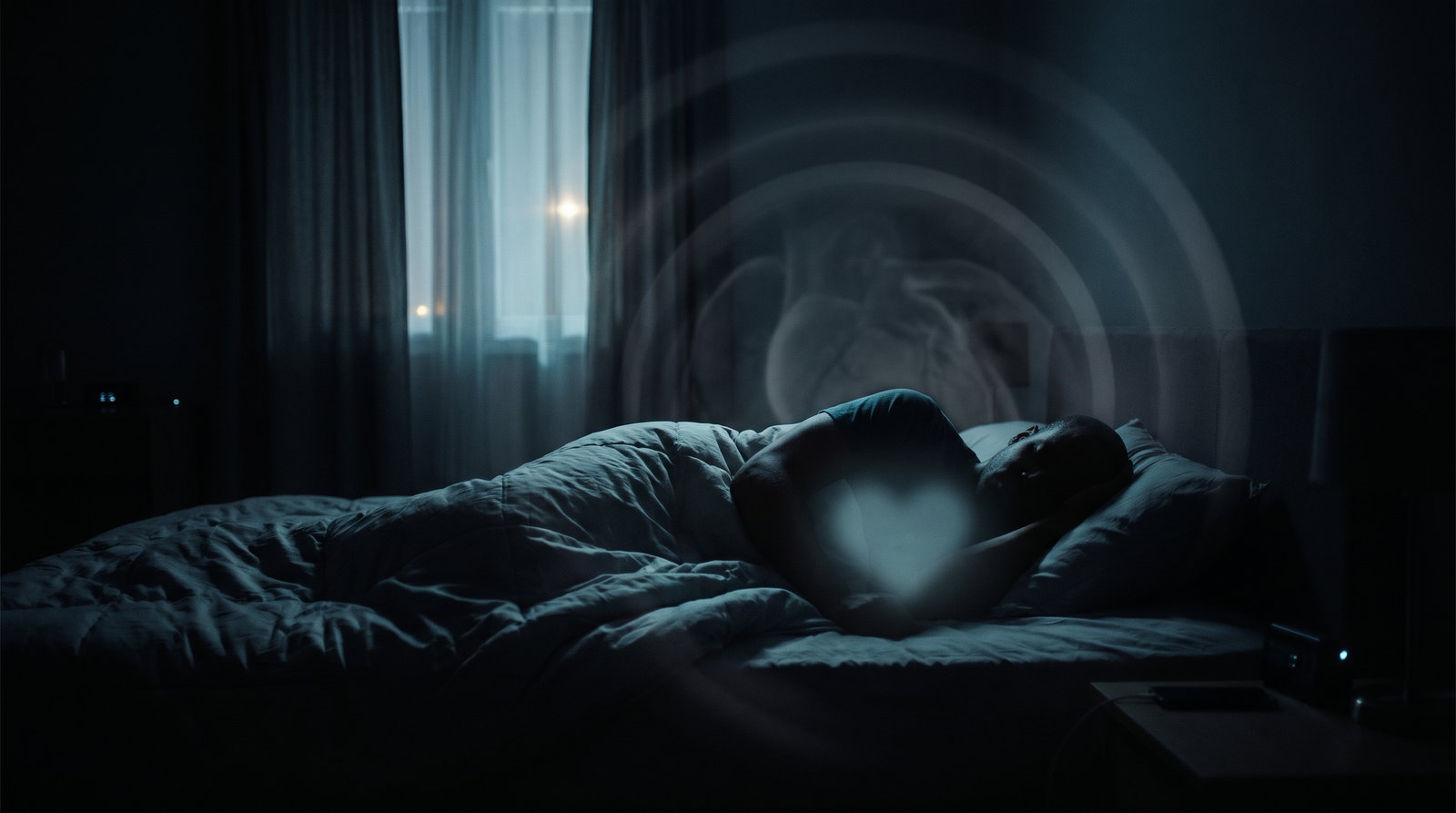
Your heart can tell how dark your bedroom is. In a new study of more than 11,000 adults in the UK, people exposed to even dim light during their darkest hours of the night had thicker, weaker heart muscle on cardiac MRI about three years later. In a larger group of about 73,000 people followed for up to a decade, the same nighttime light was linked to more heart failure, stroke, atrial fibrillation, heart attacks, and heart-related deaths. Shorter sleep explained part of the link. Let's take a closer look.
If these newsletters are a regular part of how you stay informed on health and longevity, consider supporting the work with a Pro membership. $19.99 per quarter, about $1.67 per issue, less than a coffee tip.
Join here: Become a Member
Review Your Learnings: Newsletter Summaries ✨
Nighttime Light Exposure and Cardiac Structure and Function
How did researchers measure light at night?
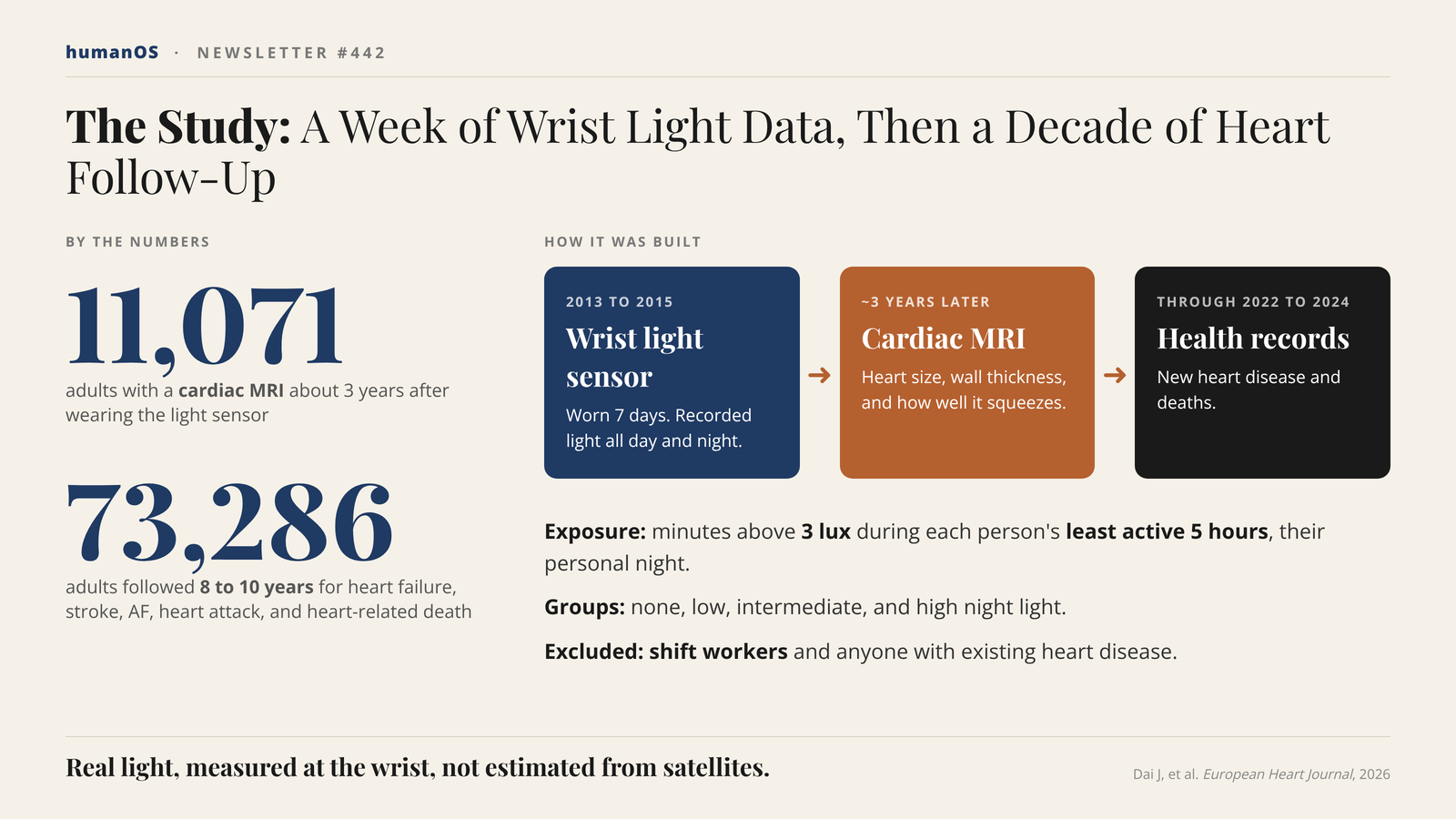
Each person wore a light sensor on their wrist for a week. That makes this a measure of the light people actually lived in, not an estimate from satellite maps of streetlights.
Light at night is any light that reaches you during your biological night, the hours when your body expects darkness. Researchers also call it artificial light at night or nighttime light exposure.
The participants came from the UK Biobank. Between 2013 and 2015, they wore a wrist device that tracked movement and light around the clock for seven days. The researchers didn't use a fixed clock time to define night. They used each person's own least active five hours, which better matches individual body clocks. Shift workers and anyone with existing heart disease were left out.
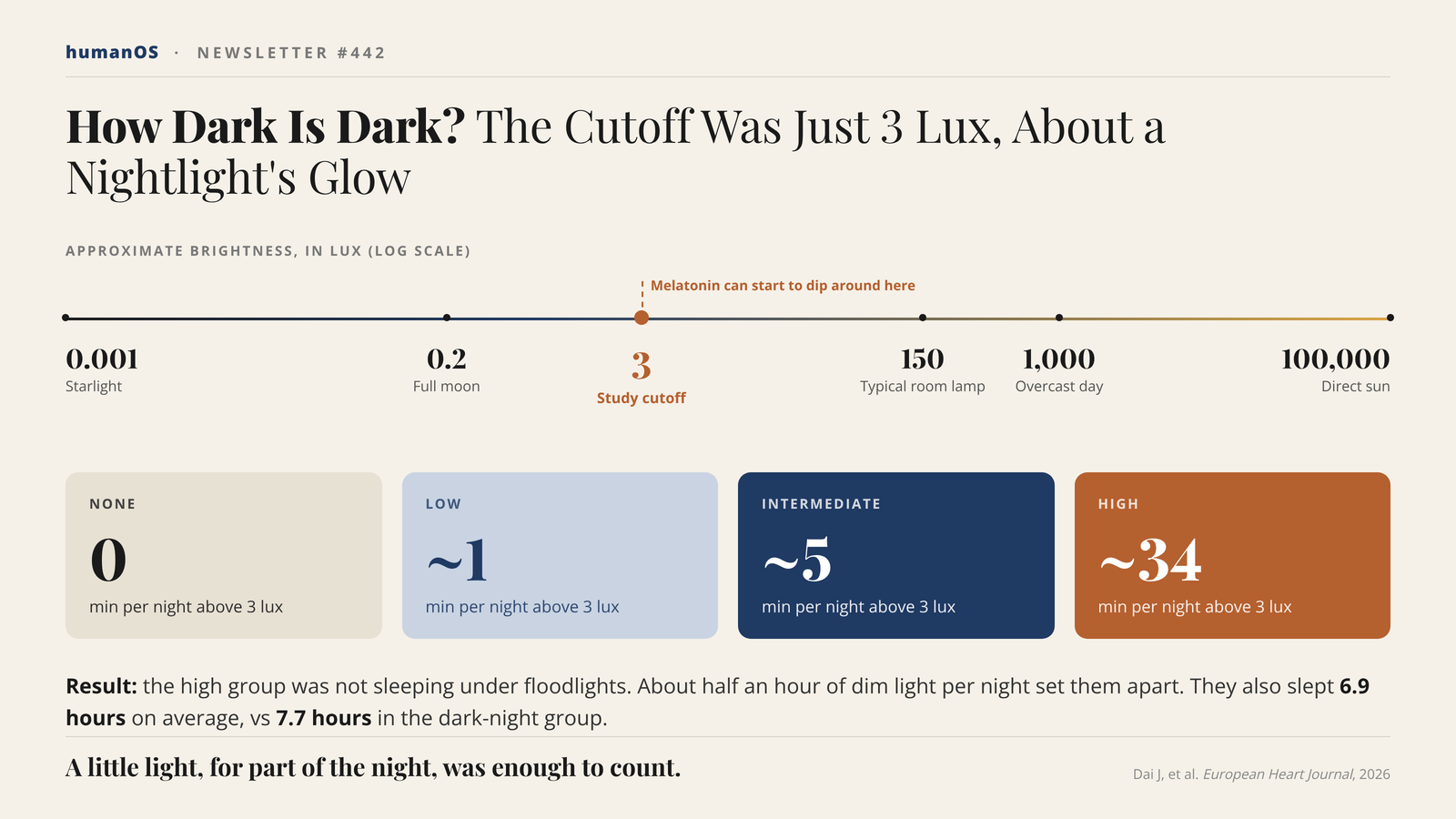
The key cutoff was 3 lux. Lux is a unit of brightness. Three lux is dim, roughly the glow of a small nightlight and far below normal room lighting. It is also about the level where light can start to suppress melatonin, the hormone that tells your body it's night.
People were sorted into four groups by how much time they spent above that cutoff. More than a quarter had none at all. The highest group averaged about half an hour per night. No floodlights. Just a dim glow for part of the night.
What did the heart scans show?
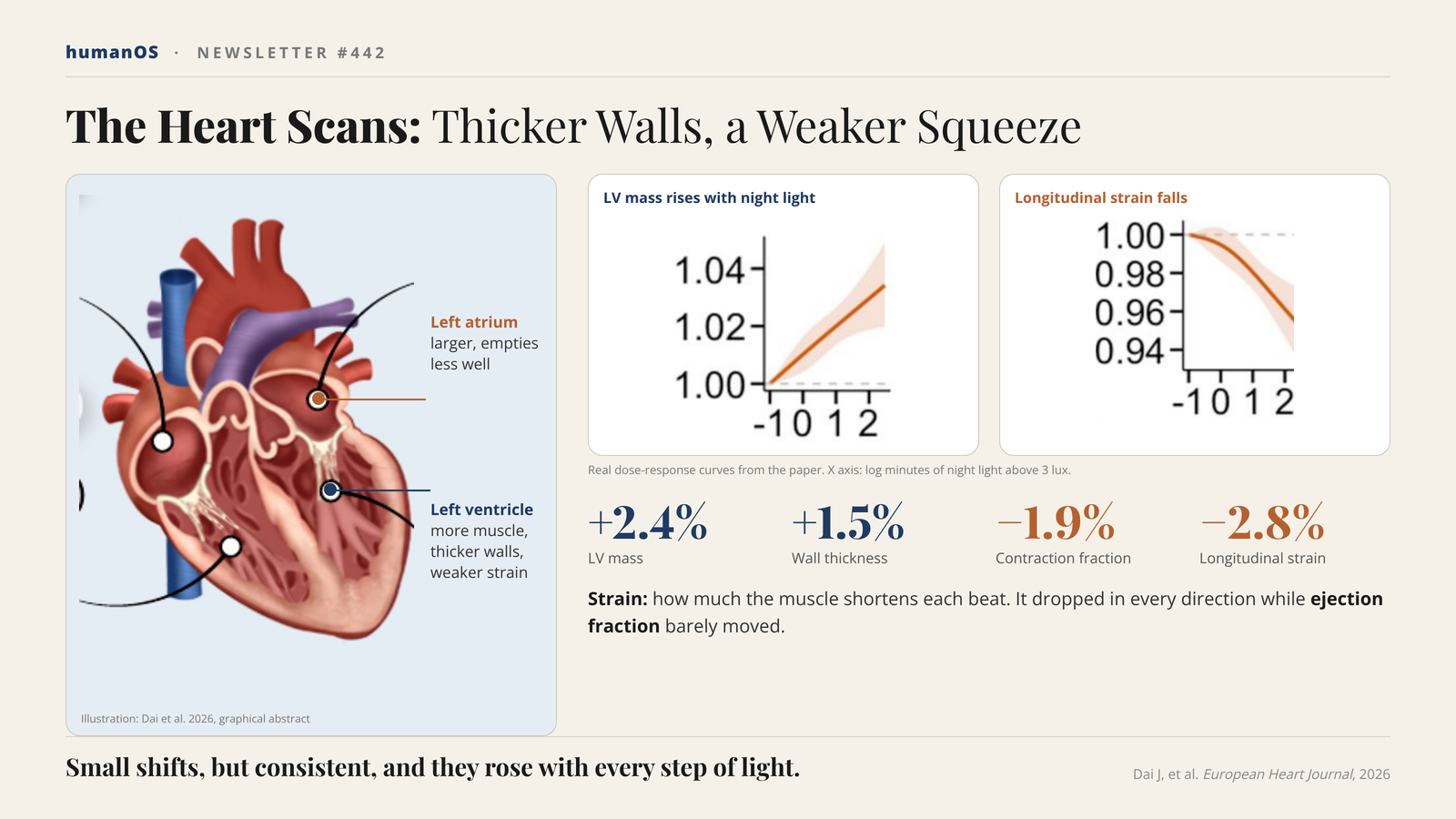
People with the most light at night had hearts that were thicker and squeezed less well. About three years after the light tracking, more than 11,000 participants had a cardiac MRI, the most precise way to measure the heart's structure and function.
Compared with people who had dark nights, the high-light group showed three kinds of change.
- Thicker heart muscle. The main pumping chamber, the left ventricle, had more muscle and thicker walls without getting bigger inside. Doctors call this concentric remodelling. It's how the heart adapts to extra workload over time, as it does with high blood pressure.
- A weaker squeeze. Myocardial strain measures how much the heart muscle shortens and deforms with each beat. Strain was lower in every direction measured.
- Changes in other chambers. The right ventricle and the left atrium were slightly larger, and the left atrium emptied less well. An enlarged left atrium sets the stage for atrial fibrillation.
Ejection fraction, the standard pumping measure doctors usually check, barely moved. Strain picked up the change first. These finer measures can show a heart starting to struggle before routine tests flag a problem.
Each change was small, a few percent. But the pattern held across many measures, and it rose steadily with more light. The authors note the changes are similar in size to those reported for air pollution and aircraft noise in the same imaging data.
Did light at night raise heart disease risk?
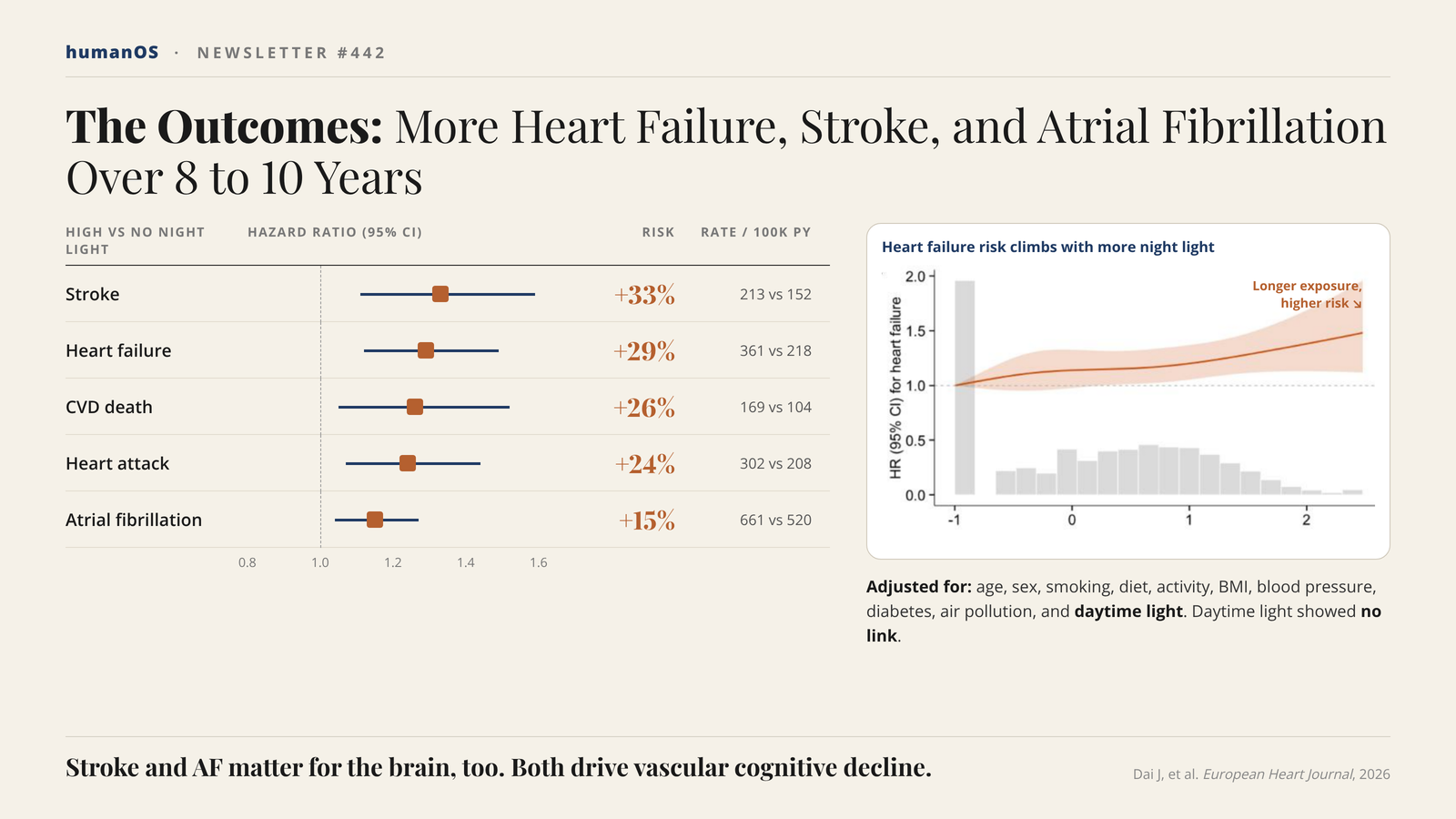
Yes. Among about 73,000 participants followed for roughly eight to ten years, those with the most light at night had more cardiovascular events than those with dark nights.
Outcome | Risk in the high-light group |
Stroke | About 33% higher |
Heart failure | About 29% higher |
Cardiovascular death | About 26% higher |
Heart attack | About 24% higher |
Atrial fibrillation | About 15% higher |
These results held after accounting for age, sex, education, income, smoking, alcohol, diet, physical activity, body weight, blood pressure, diabetes, air pollution, and season. Stroke and atrial fibrillation matter for the brain too. Both are major drivers of vascular cognitive decline.
Bright daytime light showed no link with heart disease. That contrast is telling. If night light were only a marker of city living or an unhealthy routine, daytime light patterns would likely show something too.
This adds to an earlier UK Biobank study we covered on nighttime light exposure and heart disease risk. That study linked night light to heart events. This one shows what may be happening to the heart along the way.
Your Heart Keeps Track of Your Nights
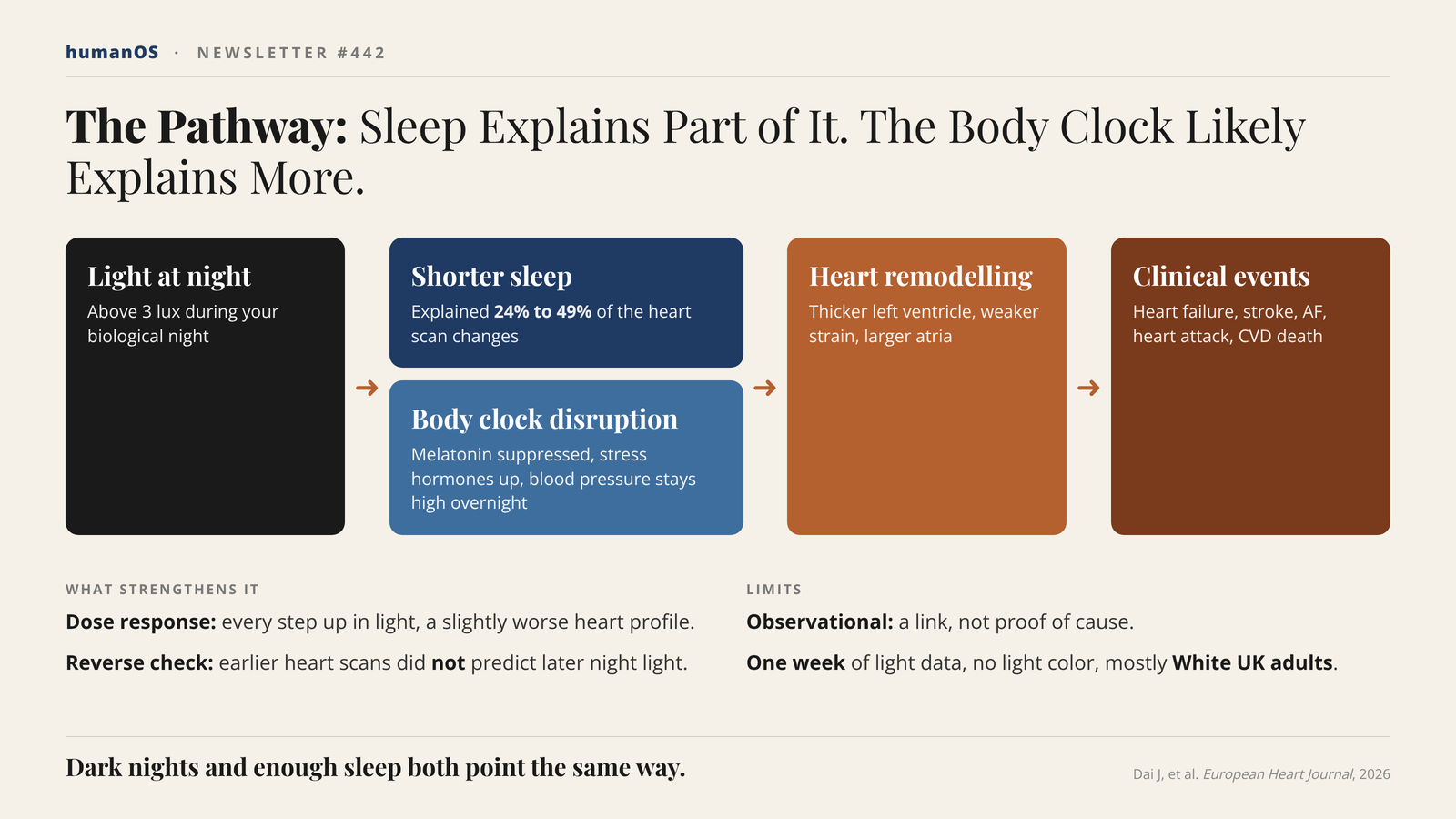
Shorter sleep explained part of the link. People in the high-light group slept a little under seven hours a night, close to an hour less than people with dark nights. Shorter sleep accounted for roughly a quarter to half of the heart changes seen on MRI.
The rest likely runs through the body clock. Light at night suppresses melatonin and tells the brain it's still daytime. When that signal arrives at the wrong time, stress hormones stay elevated, blood pressure doesn't dip the way it should overnight, and blood vessels take more wear. Over years, the heart adapts to that extra load by thickening.
There are limits. This is an observational study, so it shows a link, not proof of cause. Light was measured for one week, and the sensor couldn't tell blue light from warm light. Participants were mostly White, middle-aged and older, and healthier than average. The researchers did check the reverse story, that a struggling heart leads to restless, lit-up nights. In people scanned before they wore the sensor, earlier heart scans did not predict later night light.
Darker nights are one of the simplest heart habits available.
- Block outside light with blackout curtains or shades.
- Cover or unplug small LEDs on chargers, TVs, and clocks.
- Keep phones out of the bedroom, or at least face down.
- If you need a night light, use a dim, warm one placed low.
- Wear a sleep mask when you can't control the room.
Then do the other half during the day. Get bright light, ideally outdoors, in the morning and early afternoon. A strong contrast between bright days and dark nights gives your body clock the clearest signal.
Common Questions
What is light at night?
Light at night is any light that reaches your eyes during your biological night, when your body expects darkness. Common sources are lamps, screens, standby LEDs, and streetlight through windows.
How much light at night is too much?
This study used 3 lux as its cutoff, about the glow of a small nightlight. Light around that level can begin to suppress melatonin, so darker is better.
What is myocardial strain?
Myocardial strain measures how much the heart muscle shortens and deforms with each beat. Lower strain can signal early weakening before ejection fraction changes.
Does a sleep mask help?
This study measured light at the wrist, so it didn't test sleep masks. A well-fitted mask keeps light from reaching your eyes, which is what your body clock responds to.
Does daytime light affect heart disease risk?
In this study, bright daytime light was not linked to heart disease. Daytime light still helps set your body clock and sleep timing.
Summary: Dai, Dai, Heianza, and Qi (2026, European Heart Journal) studied UK Biobank adults who wore a wrist accelerometer with a light sensor for 7 days (2013 to 2015). Night was each person's least active 5 hours, and exposure was minutes above 3 lux. Among 11,071 CVD-free participants with cardiac MRI a median 3.1 years later, high vs no night light was linked to 2.4% greater LV mass index (95% CI 1.6 to 3.1), 1.5% greater mean wall thickness, 1.9% lower myocardial contraction fraction, and lower global circumferential (−2.7%), radial (−2.9%), and longitudinal (−2.8%, 95% CI −3.9 to −1.7) strain, plus RV and LA dilatation. LVEF did not change significantly. Shorter sleep (6.9 vs 7.7 h) mediated 24% to 49% of the CMR associations. In up to 73,286 participants followed 7.9 to 9.5 years, high night light was linked to higher risk of HF (HR 1.29), stroke (1.33), MI (1.24), AF (1.15), and CVD death (1.26). Daytime light above 1,000 lux showed no association with outcomes.
Random Trivia & Weird News
The Full Moon Is Dimmer Than a Nightlight
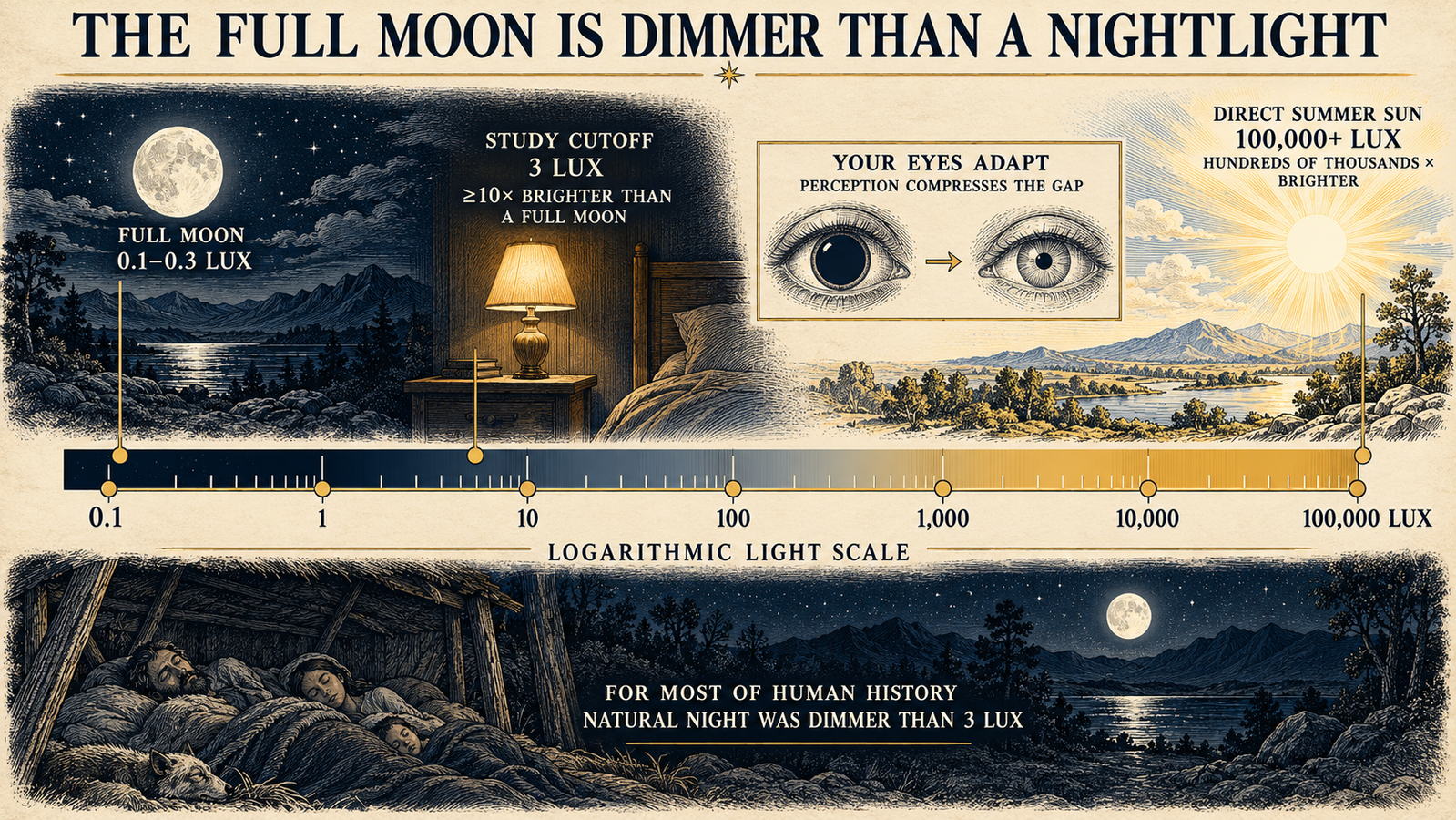
A full moon lights the ground at roughly 0.1 to 0.3 lux. Direct summer sun can top 100,000 lux, hundreds of thousands of times brighter. Your eyes hide this gap by adapting, so moonlight feels brighter than it is. The 3 lux cutoff in this week's study is ten or more times brighter than the full moon. For most of human history, the brightest natural night anyone slept under was dimmer than that cutoff.
A Week of Camping Resets Your Clock
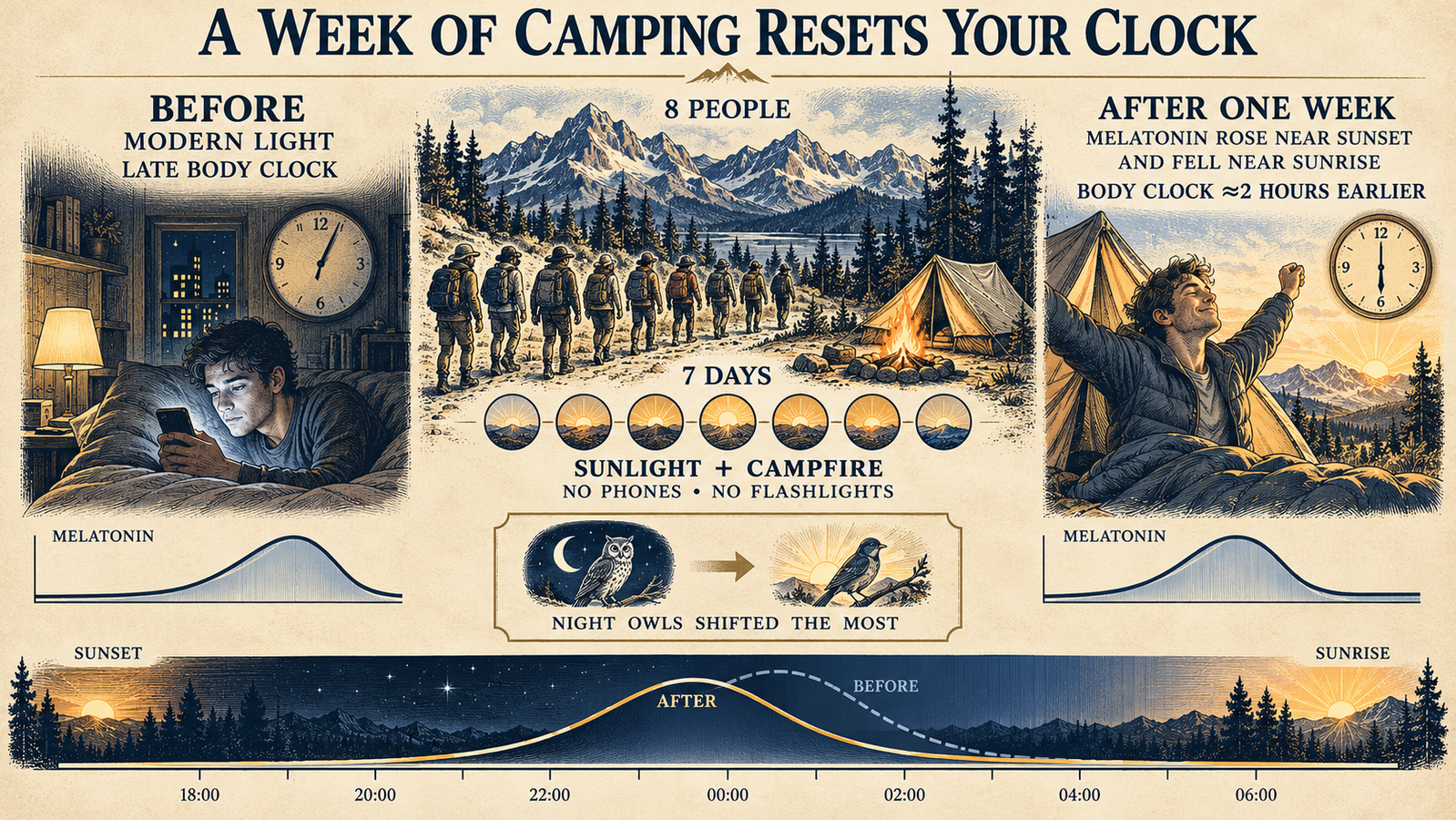
In 2013, Kenneth Wright and colleagues at the University of Colorado took eight people camping in the Rocky Mountains for a week. No flashlights, no phones, only sunlight and campfire. After a week outdoors, their melatonin began rising near sunset and fell near sunrise. Their body clocks had shifted about two hours earlier. Night owls shifted the most and ended up looking like early birds.
The Eye Cell That Doesn't See
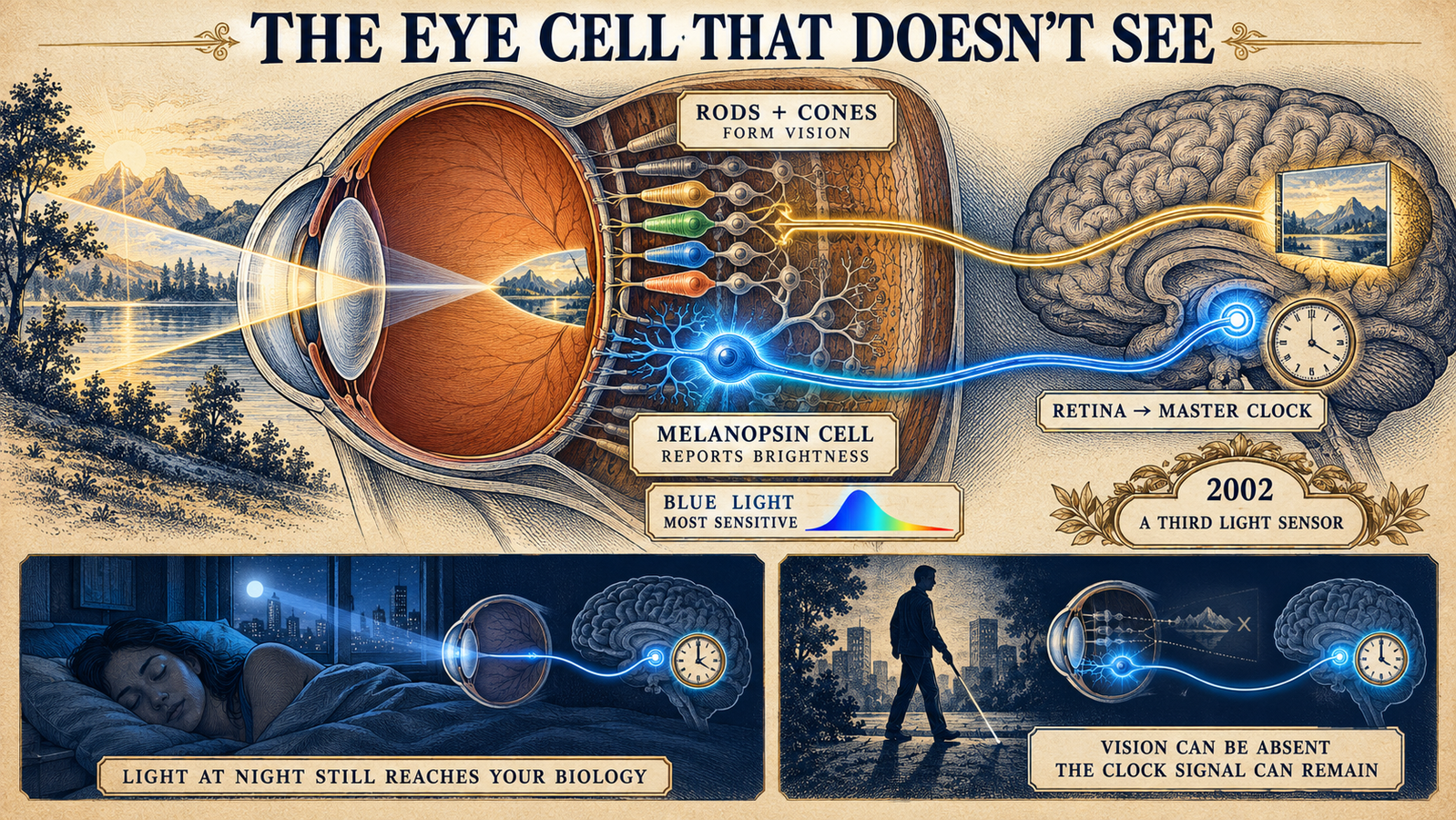
For over a century, scientists thought rods and cones were the eye's only light sensors. In 2002, researchers including David Berson and Samer Hattar showed otherwise. A small set of retinal cells contains melanopsin, a pigment most sensitive to blue light. These cells don't help you see. They report brightness to the brain's master clock. That's why some people who are fully blind can still have melatonin suppressed by light, and why light at night reaches your biology even half asleep.
Products We Love
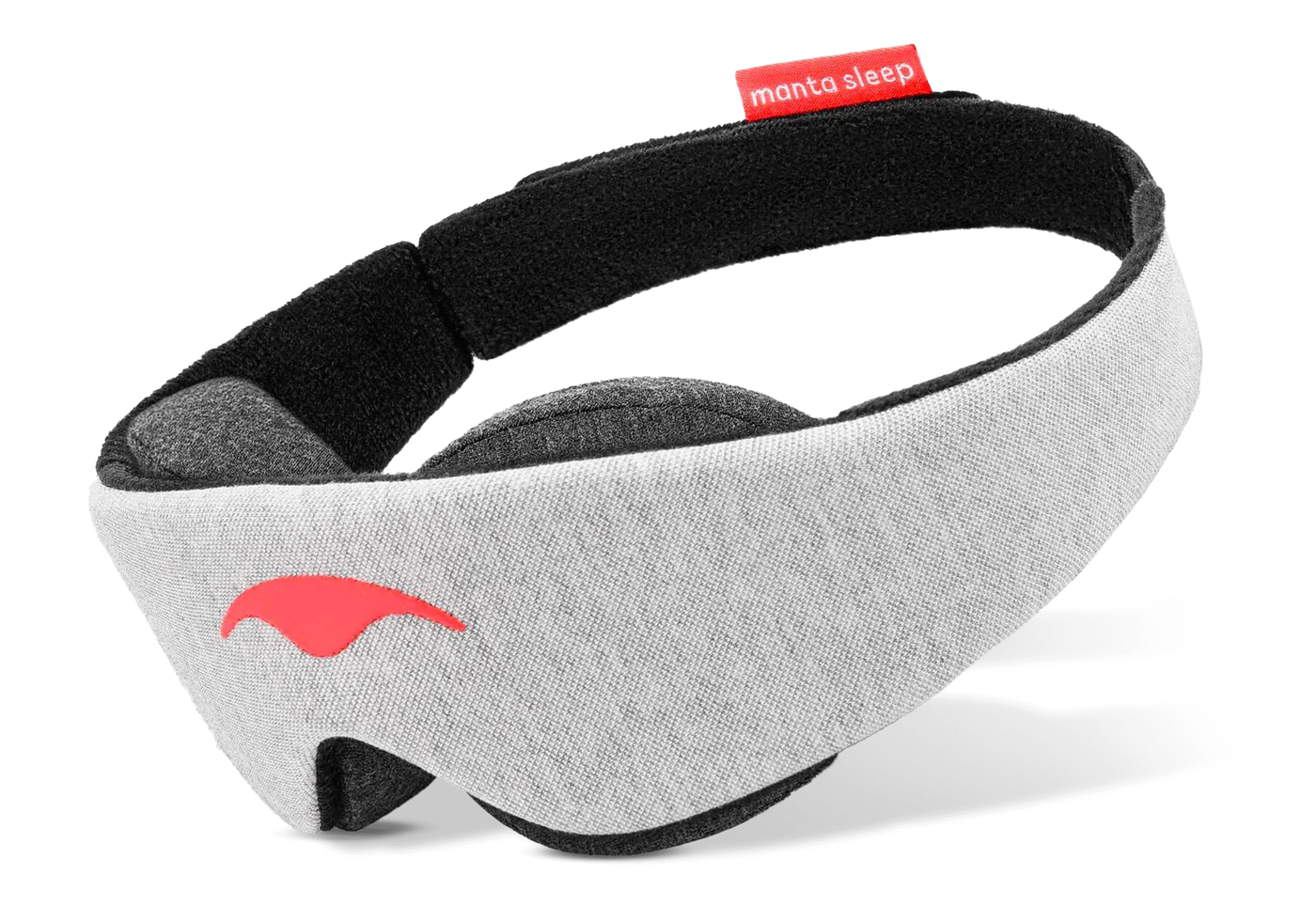
Manta Sleep Mask
A sleep mask is the fastest way to make any room dark. The Manta Sleep Mask uses two adjustable eye cups that sit around your eyes instead of pressing on them, so you can blink freely and side sleepers stay comfortable. The cups slide along the strap to fit different face shapes, which is what lets it block light fully. The cups are made of soft modal fabric and the strap is breathable. It's handy for travel, hotel rooms, and early summer sunrises.
humanOS Catalog Feature of the Week
The How-to Guide to Smart Daily Light
How dark is dark enough? This guide covers the full 24-hour light cycle, from morning sunlight to the last lamp you switch off before bed. It explains why most indoor lighting is too dim during the day and too bright at night, and how that blurs the signal your body clock depends on. Then it gets practical. You'll learn how to set up a bedroom for real darkness, tune screens and indoor lights for the evening, and use daytime light to sharpen the contrast between day and night.
Enjoying these? A Pro membership keeps the newsletter going and unlocks the full humanOS library of courses, guides and protocols. $19.99 per quarter.
Join here: Become a Member
Wishing you the best,