
Newsletter #424
Depression treatment usually begins with a question of which tool to reach for. A medication, a course of therapy, a change in routine. Exercise has earned a place on that list, and heated yoga has drawn fresh attention as a version that seems to help people carrying serious depressive symptoms. An earlier trial showed it worked. What that trial could not answer was more practical. Once a person starts going to class, does showing up more often actually buy more relief, or does the benefit arrive early and then level off?
Become a member of humanOS and turn what you read here into what you do. Courses, guides, and tools that make the science practical. Join us.
Review Your Learnings: Newsletter Summaries ✨
Heated yoga thaws depression: A dose-response analysis from a randomized controlled trial
This new paper is a fresh look at heated yoga in adults with moderate to severe depression. The original study compared people who started yoga right away against people who waited. This analysis asked a different question, so the researchers pooled everyone together. Their reasoning was practical. When they looked at who improved, most of the variation tracked with how much yoga a person actually did, not with which group they had been assigned to. So they set aside the group labels and focused on a single number for each participant, the count of classes attended.
That reframes heated yoga as something closer to a prescription. Instead of asking only whether the practice works, the question becomes how much of it a person needs. Each additional class a participant attended was linked with a further drop in their clinician-rated depression score. People who came more often tended to feel better, and the connection was steady enough to be confident with the findings.
A straight line with no ceiling
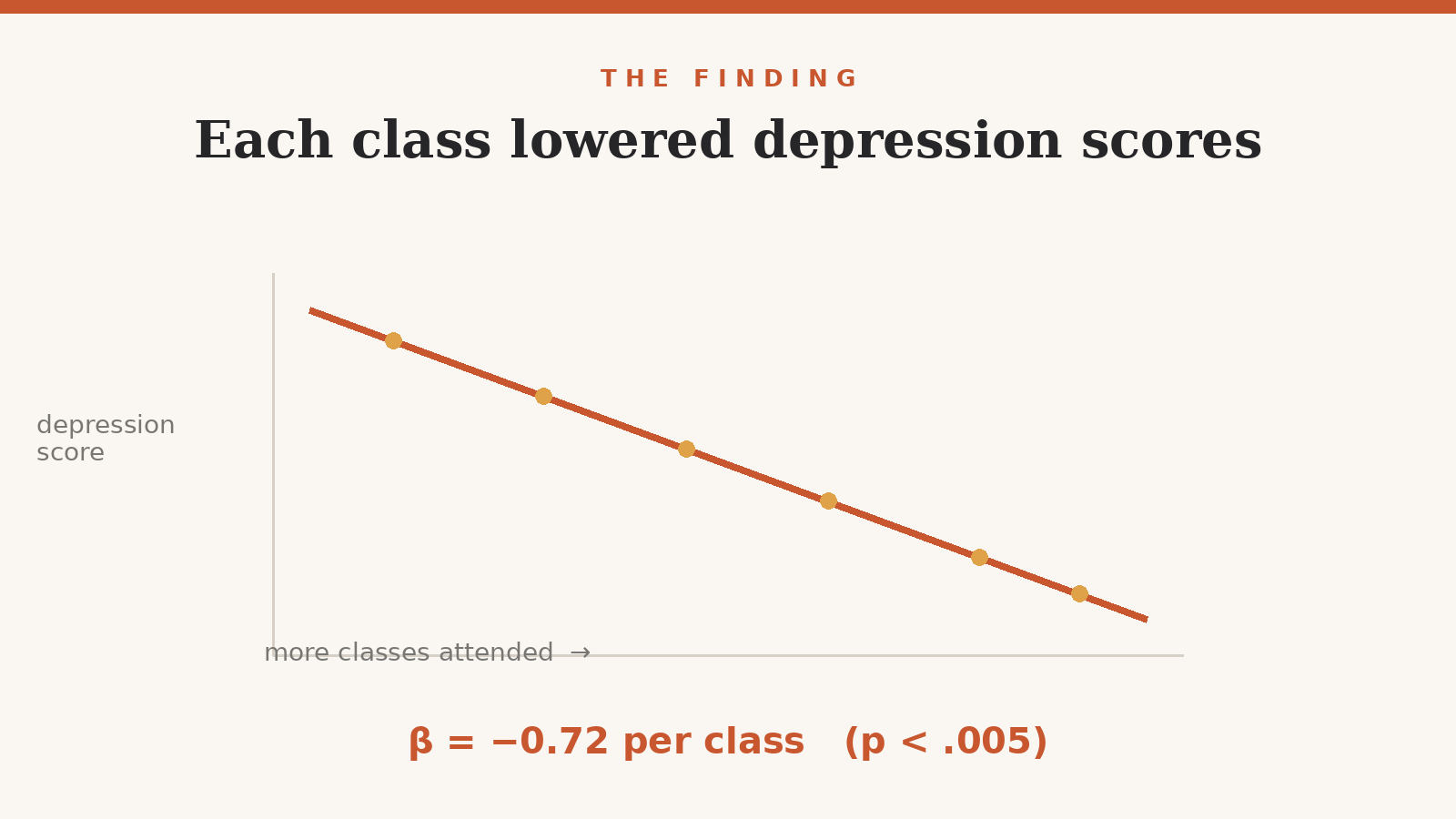
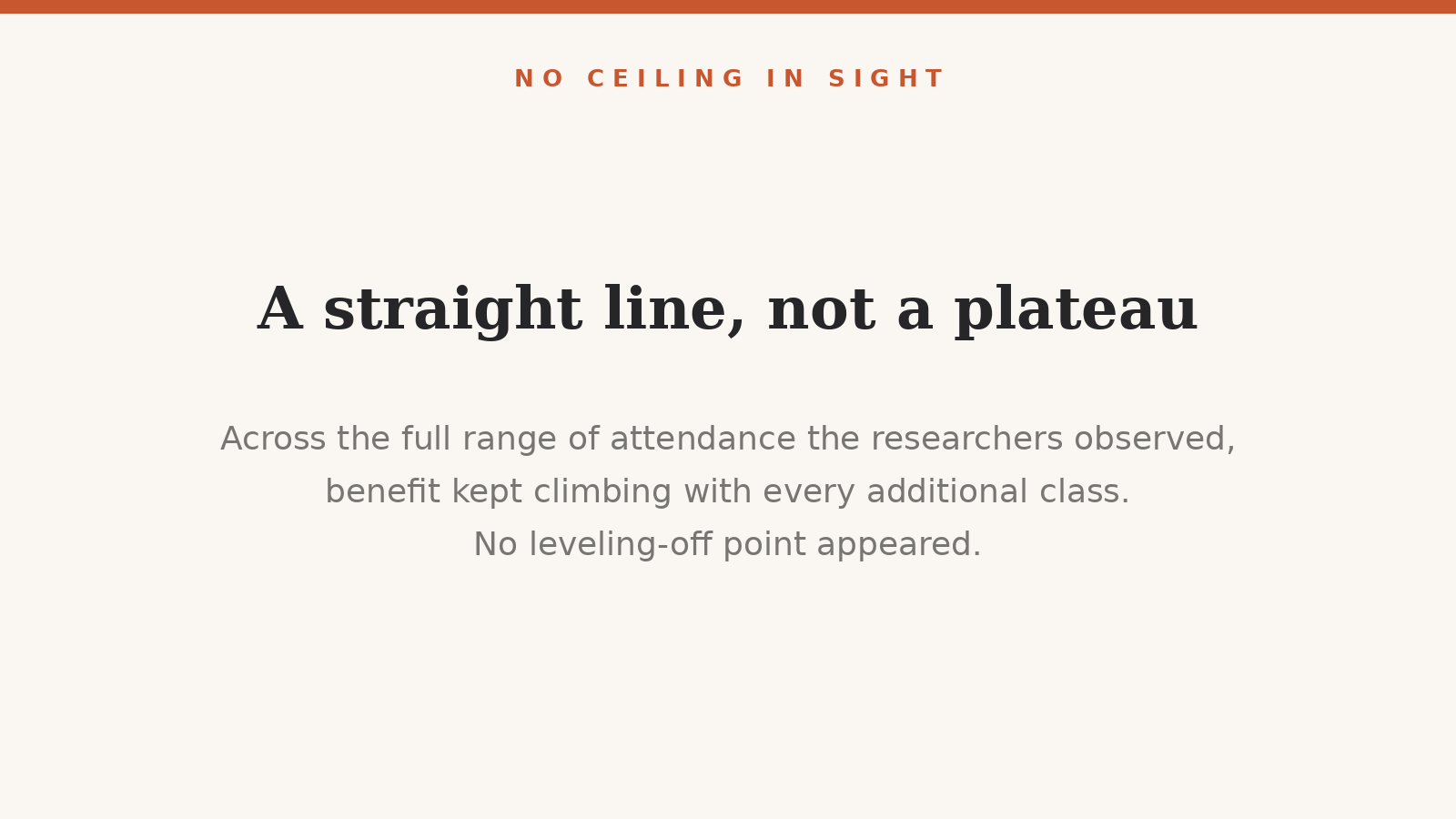
The shape of that relationship is the part worth noticing. Benefit did not arrive in a single burst and then flatten. It kept climbing with attendance, in a roughly straight line across the full range the researchers observed. They did not find a point where extra classes stopped adding value.
One caution belongs here. Attendance was not assigned by the researchers, so this is an observed pattern rather than a controlled comparison. People who make it to more classes may differ in other ways that also lift mood, things like sleep, social contact, or how severe their symptoms were to begin with. The authors are direct about this. They call for a trial that randomly assigns people to different attendance targets, which is the cleaner way to show that more classes cause more improvement.
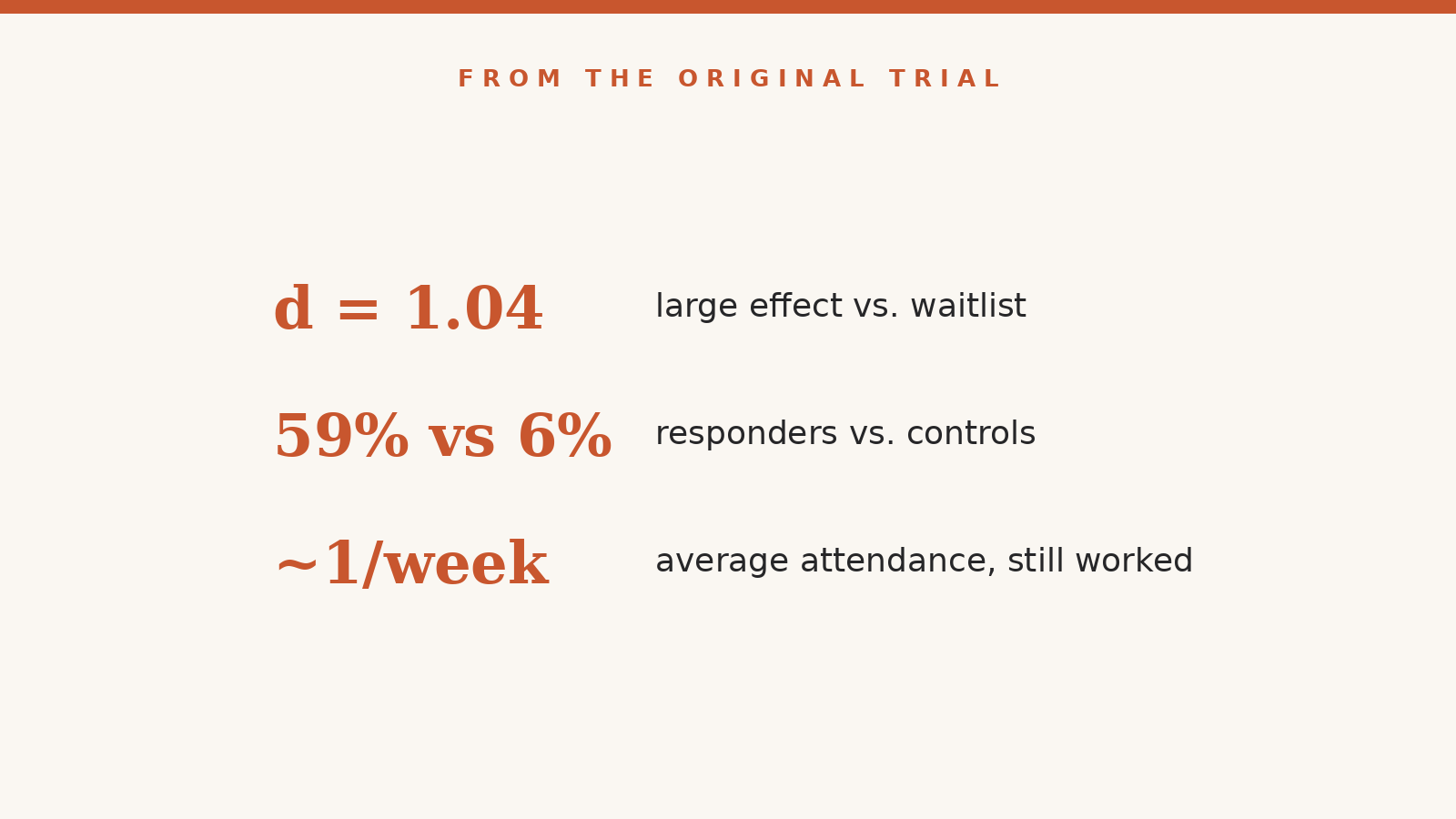
Set against the original trial, the picture is encouraging from both ends. In that study, people attended only about one class a week on average and still showed a large benefit compared with waiting. This analysis suggests there is likely more to gain by going more often. A little helps, and more appears to help more.
Treat Attendance Like A Dose
Heated yoga stacks two challenges the body learns to handle, the heat of the room and the physical work of the practice. Both are mild stressors, and the body adapts to repeated exposure. That framing helps explain why frequency would matter. Each session is another round of the same adaptive signal, and the effect builds with repetition rather than topping out after a few visits.
The takeaway is less about yoga specifically and more about how to think about movement for mental health. We often treat these practices as either something you do or something you don't. This study points toward a more useful frame. Showing up is a dose, and the dose can be adjusted. For someone weighing whether two classes a week is worth it over one, the available evidence leans toward more.
Summary
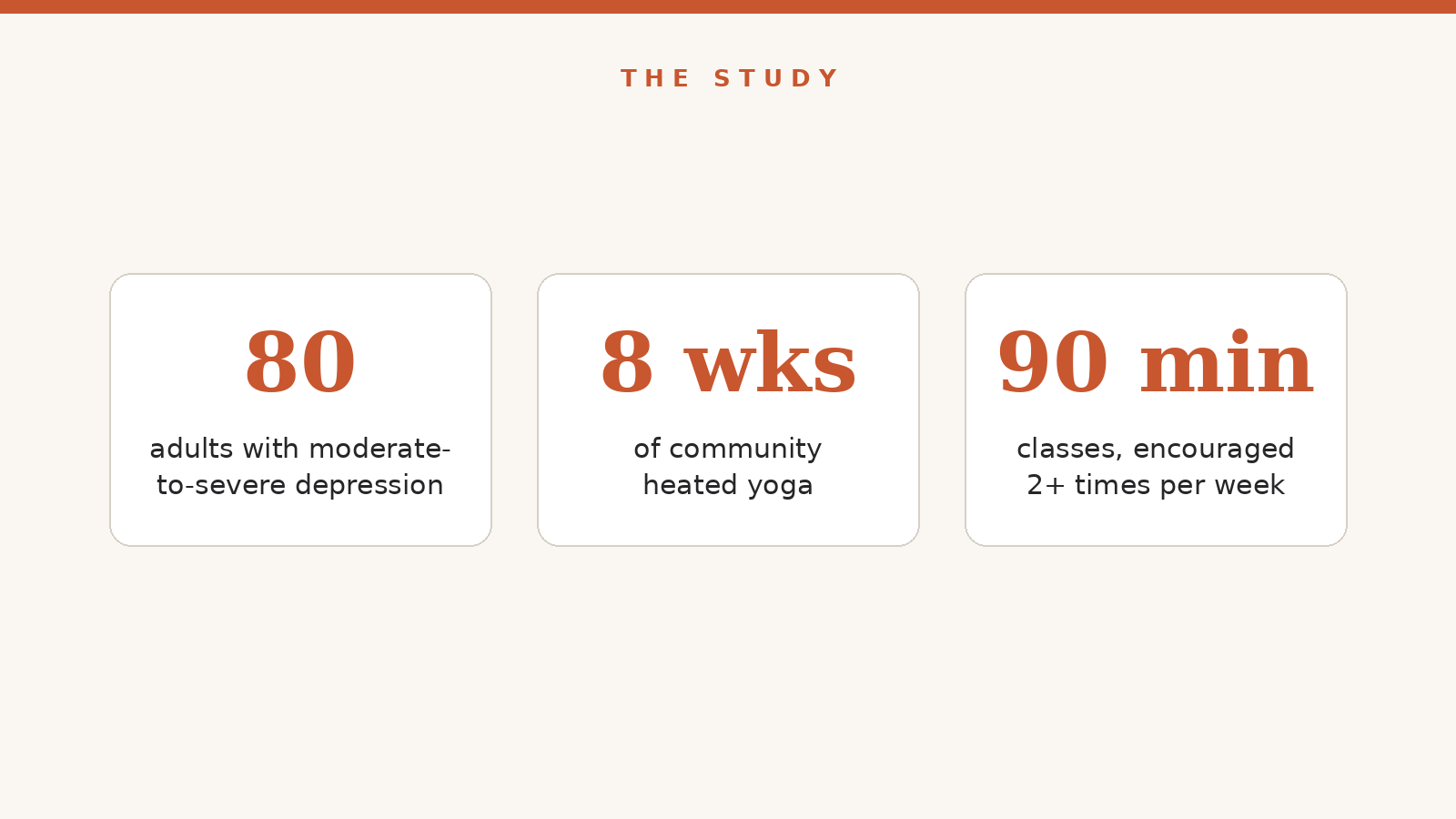
This was a secondary, dose-response analysis of an eight-week randomized controlled trial of community-based heated yoga in 80 adults with moderate-to-severe depression (clinician-rated Inventory of Depressive Symptomatology, IDS-CR ≥ 23). Classes ran 90 minutes, with at least two per week encouraged. Because most of the variation in symptom change fell within groups rather than between the yoga-first and waitlist-first arms, the researchers pooled participants and modeled outcome by number of classes attended. The relationship was linear and significant. Each additional class predicted about a 0.72-point reduction in IDS-CR (β = −0.72, SE 0.24, p < .005), with no plateau across the observed range. The parent trial had shown a large overall effect versus waitlist (Cohen's d = 1.04), with 59.3% of yoga participants responding versus 6.3% of controls, despite an average of only 10.3 classes attended. Because attendance was not randomized, the dose effect is associational, and the authors call for trials that randomize attendance.
Random Trivia & Weird News

Saunas And The Finnish Mind
Finland has around three million saunas for a population of five and a half million, close to one per household. Beyond the cultural ritual, large Finnish studies have linked frequent sauna bathing to lower rates of cardiovascular disease and, in some cohorts, a reduced risk of developing psychotic disorders and depression. Heat exposure may share pathways with exercise, which reminds up once again that this steamy national pastime is not just an indulgence, it’s meaningful self care.

Monkeys That Soak Off Stress
In the mountains of Nagano, Japan, wild macaques famously bathe in natural hot springs through the winter. Researchers measured their stress hormones and found that the monkeys who soaked had lower cortisol than those who did not, especially in the coldest stretches. The warm water appears to genuinely calm them. Humans are not so different, which is part of why deliberate heat keeps showing up in conversations about mood.
Podcasts We Loved This Week
- Dr. Nolan Williams: Psychedelics & Tools for Depression via Huberman Lab
- Dr. Rhonda Patrick: Aliquot #146: When Is the Best Time to Exercise? via FoundMyFitness
Products We Love

HigherDOSE Infrared Sauna Blanket
Not everyone has a heated yoga studio down the street, and the research on deliberate heat keeps getting more interesting. This is the at-home version that’s more accessible in terms of space and cost. You lie down, zip in, and let the infrared heat bring on the kind of deep warmth that feels a lot like the back half of a hard sauna session. It has adjustable heat levels, low EMF, and folds away in a closet. I don’t have this blanket, so I can’t offer personal experience, but I use sauna regularly on rest days. But this product makes it easier for people to get a regular dose of heat without leaving the house.
humanOS Catalog Feature of the Week
Daily Performance and Stress
What if the stress you spend so much energy avoiding is also the thing your body needs to grow stronger? Heated yoga works partly because it gives you a controlled dose of stress your system can adapt to, and the same logic runs through nearly every part of health. This humanOS course walks through what stress actually is, why the dose and the recovery matter more than the label, and how to use it on purpose instead of being pushed around by it. If this week's study made you curious about the line between helpful and harmful stress, start here.
Ready to go deeper? humanOS members get the full library of courses, guides, and tools built to turn research like this into daily practice. Become a member.
Wishing you the best,