

Newsletter #395
This Week’s Research Highlights
Aging science has made real strides over the past few decades. We now know that diet and dietary techniques can shift lifespan, that certain gene variants influence how long organisms live, and that epigenetic clocks can give us remarkably accurate readings of biological age. Yet for all this progress, the field is still grappling with something fundamental: we don’t actually agree on why we age, or which mechanisms matter most. The result is a field full of promise but still missing the conceptual clarity needed to steer the next decade of discovery. In today's newsletter, we're going to explore a fascinating new paper that just came out.
To everyone who filled out the form to get Dr. Tommy Wood’s new book - The Stimulated Mind - for free, good for you. We will follow up with more details on this soon. Tommy is now offering another 50 free books, so if you didn't fill out the form last time, you have a second chance to do so. We'll keep this form open for another week. Fill out this form for a totally free book:
New Feature: Newsletter Summaries ✨
Open problems in ageing science: a roadmap for biogerontology
To help resolve the challenge described above, the biogerontology community recently produced a structured list of 100 open problems in aging and longevity science—a roadmap meant to define where the field stands, where it’s stuck, and where new research could have outsize impact. Think of it as a shared reference point: a way to make sure researchers, funders, and curious observers are actually talking about the same problems.
How the List Was Built—and Why That Matters
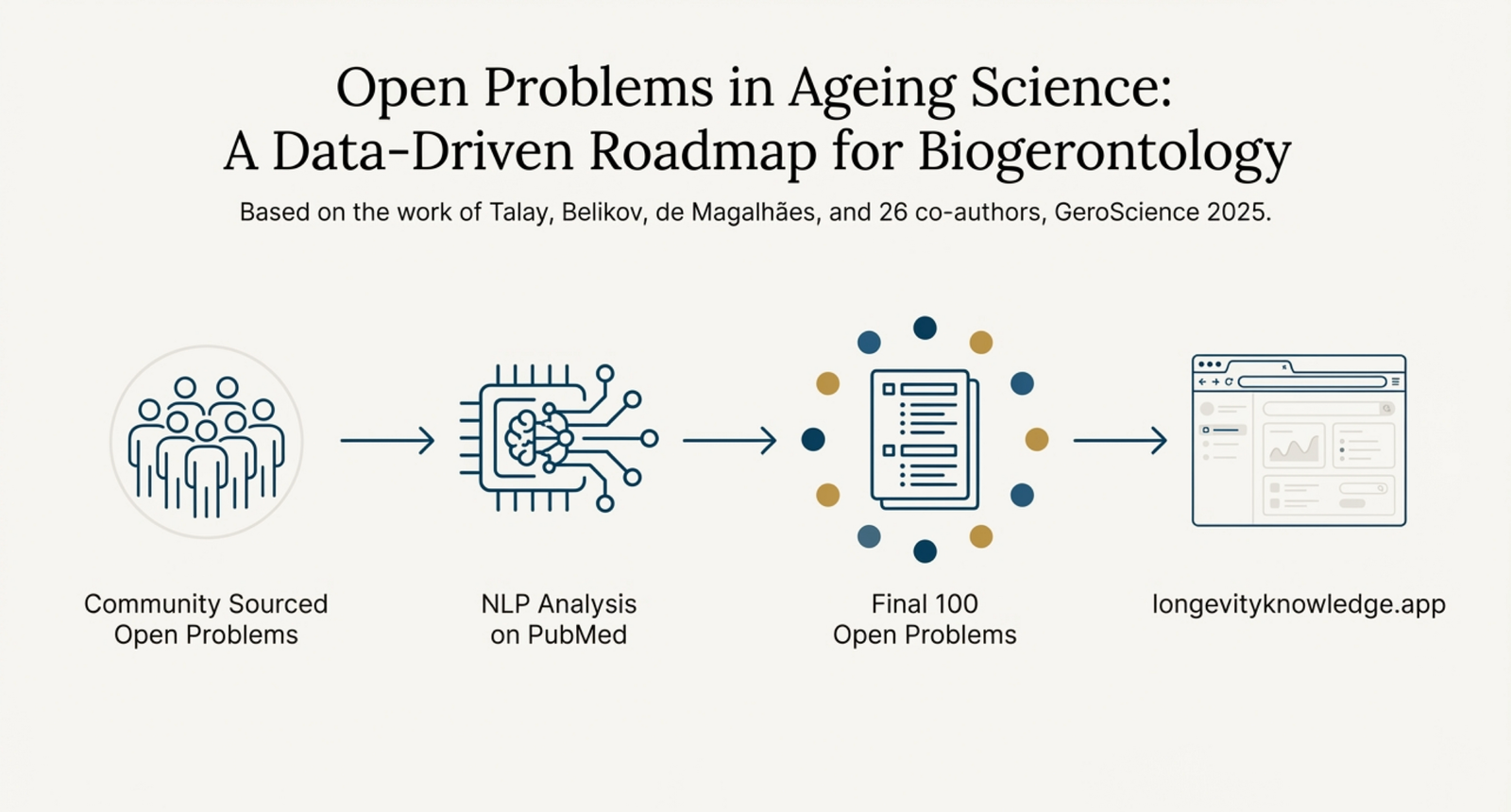
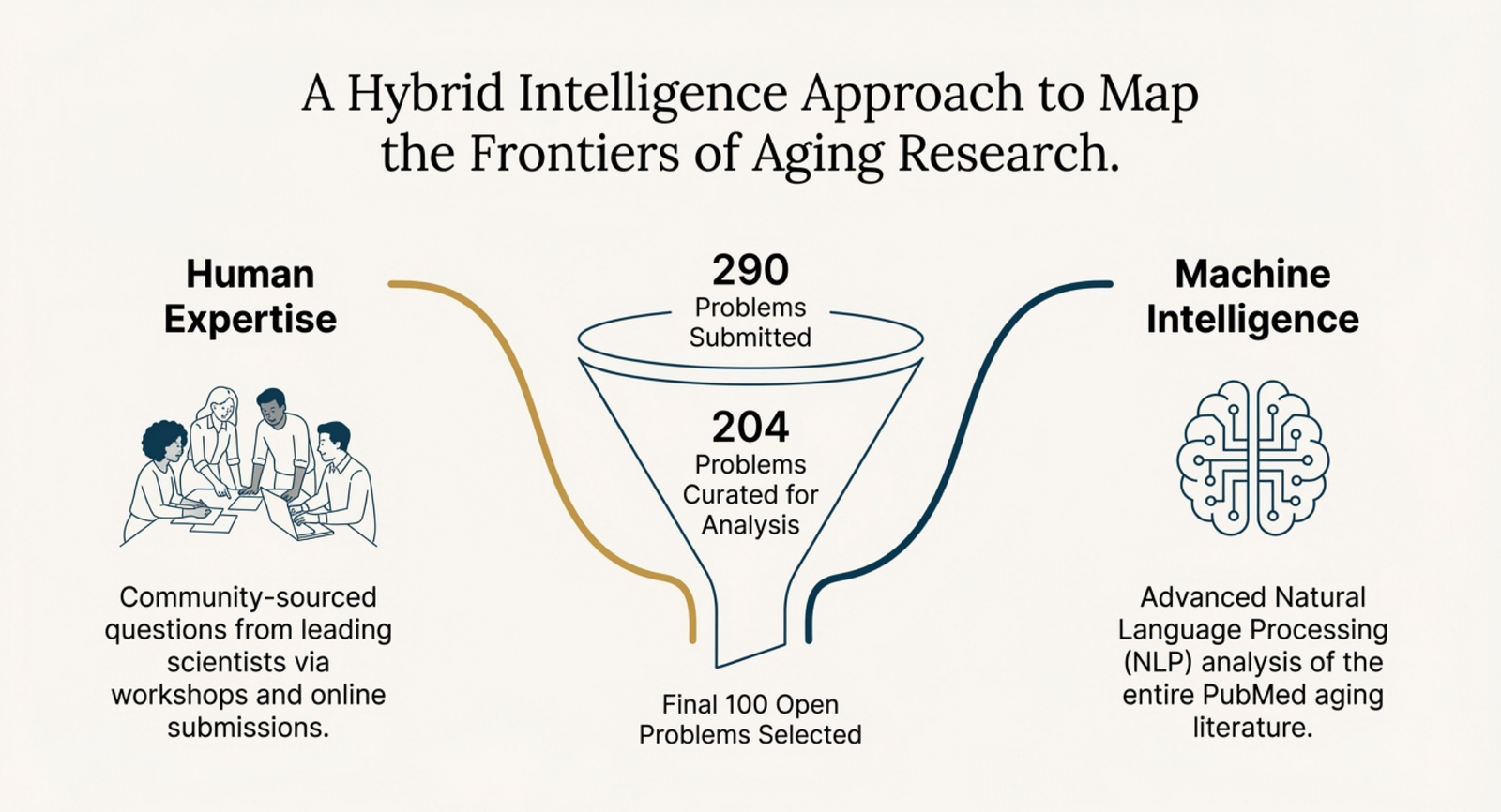
The authors approached this systematically, because identifying what we don’t know is harder than it sounds. They began with community input. This included 160 open problems submitted through a dedicated website, followed by another 130 developed during a three-day workshop with researchers and practitioners. From the resulting 290 ideas, they refined the list to 204 problems that could be analyzed in depth.
What makes this effort stand out is the use of Natural Language Processing (NLP) to map each open problem against the entire history of aging research. The team collected more than 200,000 PubMed articles indexed under “Aging” and used a multi-step NLP pipeline to identify how often each proposed problem actually appears in the literature. This gave them a quantitative sense of where research attention has clustered—and where it’s barely begun.
For readers, this method matters because it transforms subjective impressions (“We talk about X too much; we never talk about Y”) into something visible and measurable. It highlights blind spots that may not be obvious even to experts in the field.
What the Data Shows: A Field with Uneven Coverage
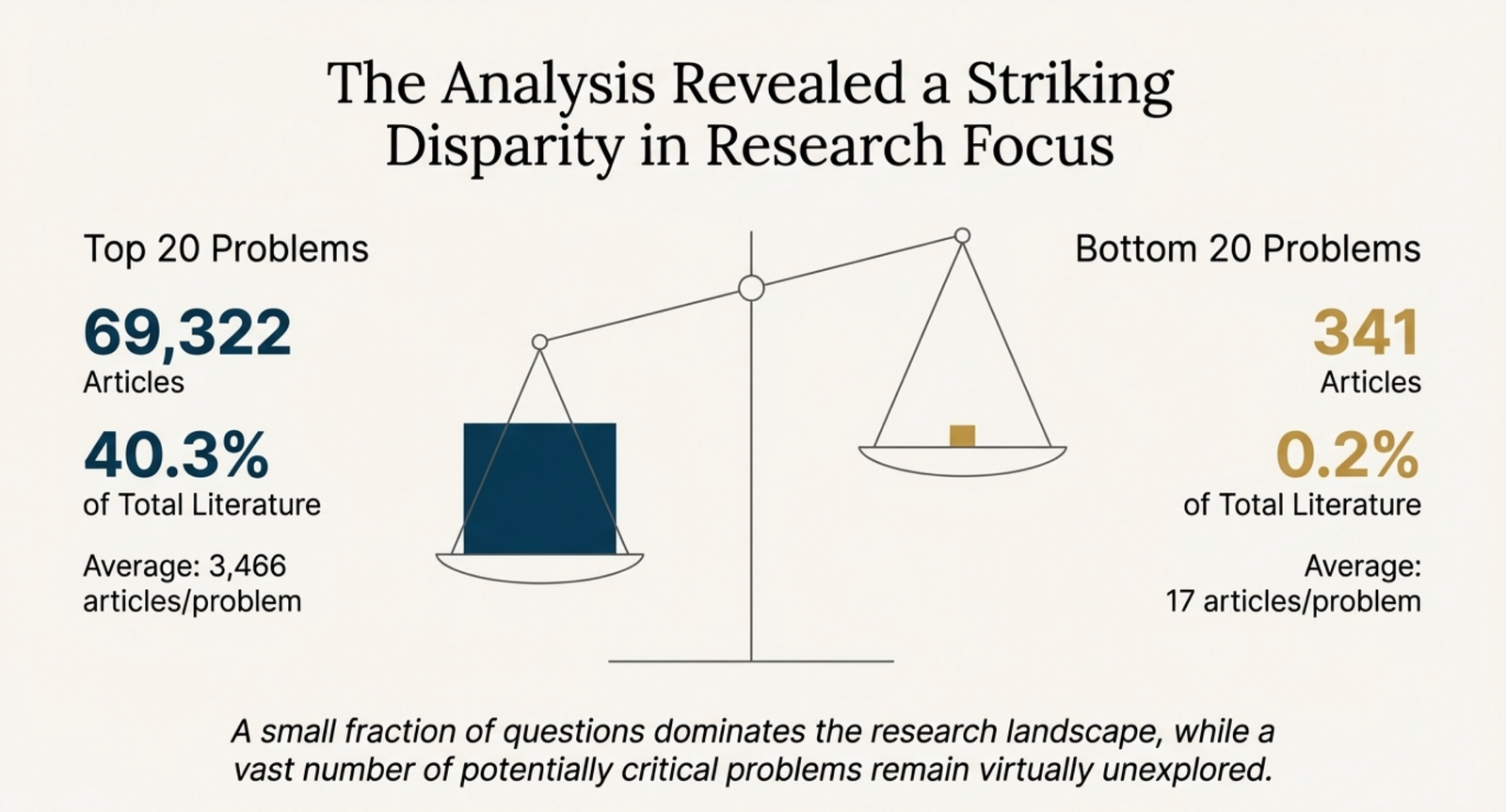
Once the NLP analysis was complete, a striking pattern emerged. The number of articles linked to each open problem ranged from a single paper to more than 10,800.
The top 20 problems—broad, foundational questions—consume over 40% of the entire aging literature. These include:
- “Why do we age?” (10,808 articles)
- “Does somatic mutation accumulation cause aging?” (5,977 articles)
- “What mechanisms determine the longevity of long-lived species?” (3,668 articles)
- “How can we measure intrinsic biological age and translate this into reliable biomarkers?” (2,545 articles)
These are the questions that have shaped the field for decades. They anchor the conceptual debates, and they absorb the bulk of research funding and attention.
At the other extreme, the bottom 20 problems represent only 0.2% of the literature—an average of 17 papers per problem. These tend to be emerging ideas, niche mechanisms, or highly exploratory therapeutic concepts. Examples include:
- “How can we measure the extent and pace of changes in the homeodynamic space during aging?” (1 article)
- “How can we break through the current human lifespan ceiling of 122 years?” (4 articles)
- “How many diseases of aging are caused by citrate trapping in mitochondria?” (36 articles)
These low-visibility topics often hold the potential for faster, more tractable progress. They are the scientific “white spaces” where a small amount of focused work could reveal new biology or clarify overlooked mechanisms.
Organizing the Unknowns: Eleven Themes That Define the Field Today
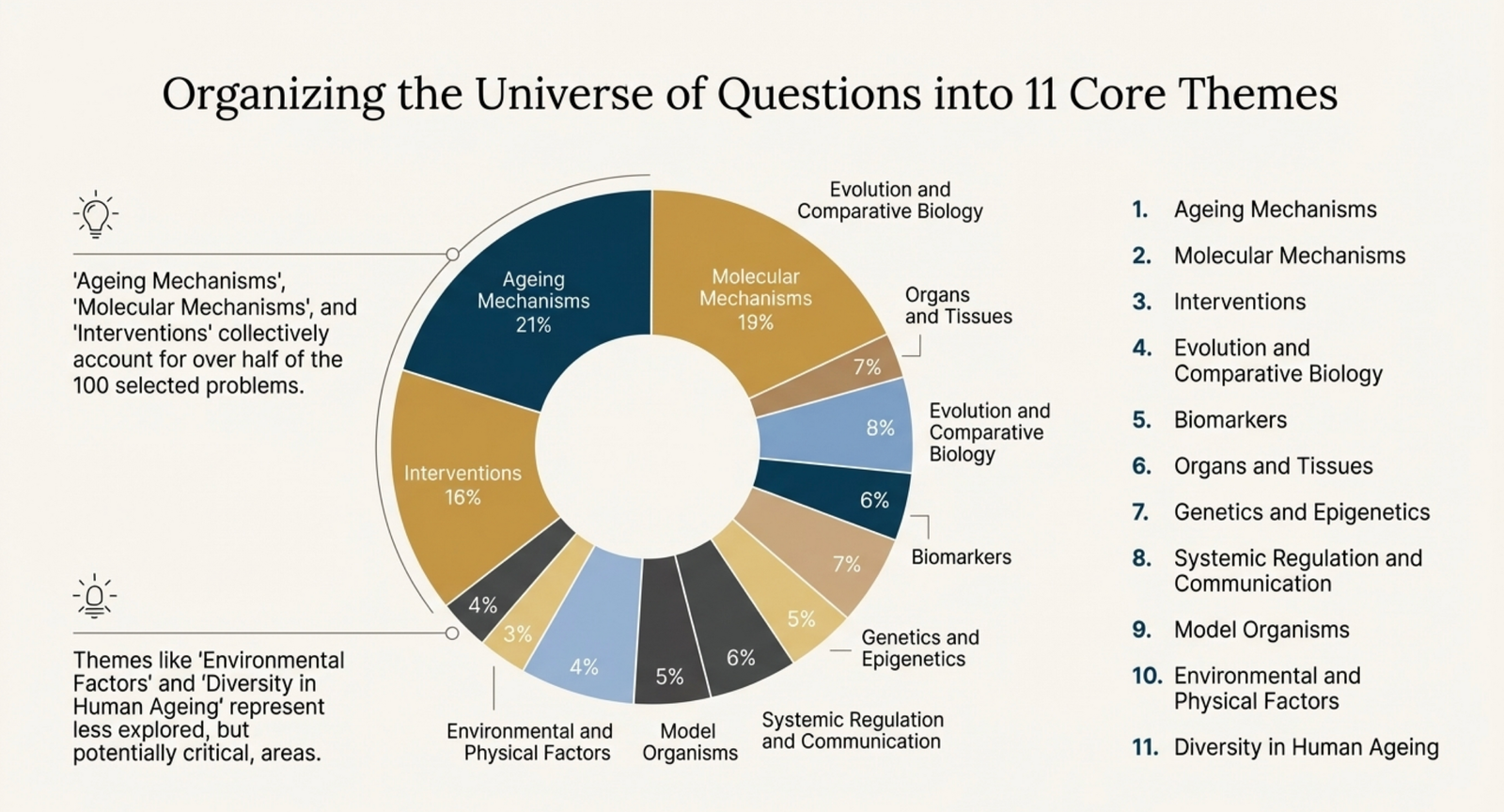
From the 204 problems analyzed, the final curated list of 100 was grouped into 11 themes, offering a structured view of where the field’s priorities currently lie. Three themes—Broader Aging Mechanisms, Molecular Mechanisms, and Interventions—account for more than half the list. This concentration reflects two realities:
- We still lack consensus on the core drivers of aging.
- There is enormous interest in developing therapies that could meaningfully extend healthspan.
But the list goes beyond the usual mechanistic debates. It includes unanswered questions about biomarkers, comparative biology, and emerging methods such as partial reprogramming. There is also a noticeable shift compared to earlier eras of biogerontology: today’s open problems emphasize interventions—how to measure them, how to develop them, and how to apply them clinically. The field is moving from description toward action.
Why This Matters for the Future of Aging Research
For researchers, this roadmap offers clarity and orientation. For funders, it highlights where investment could accelerate progress. For readers following aging science, it serves as a snapshot of what experts believe genuinely stands between us and meaningful breakthroughs.
The full, interactive list is available on the Longevity Knowledge App (www.longevityknowledge.app), where it continues to evolve as the community contributes insights and proposed solutions. Its purpose is not merely to catalog unanswered questions but to help the field move forward with greater intention and alignment.
This effort underscores something essential: progress in longevity science isn’t just about new experiments or new technologies. It’s also about asking the right questions—and knowing which ones the field has overlooked.
The analysis reveals highly uneven coverage: a small set of broad questions dominates over 40% of the literature, while many potentially important but underexplored topics have only a handful of papers. The final problems are organized into 11 themes, with emphasis on aging mechanisms, molecular drivers, and therapeutic interventions—reflecting the field’s shift toward actionable strategies.
This structured roadmap offers researchers and funders clearer priorities and exposes neglected areas where focused work could yield rapid progress.
Random Trivia & Weird News

Some early Greek physicians imagined the human body as a kind of living sponge, its strength dependent on the tightness of its pores. In youth, these pores were thought to be small and resilient, sealing in the vital substances—heat, moisture, and pneuma—that sustained life. But as a person aged, the pores slowly widened, loosening like worn fabric. With each passing year, more of the body’s essence seeped out, leaving the individual colder, drier, and weaker. Aging, in this view, was not a battle against time but a gradual leaking away of one’s inner fire.
Podcasts We Loved This Week
- Carole Hooven, Ph.D: The evolutionary biology of testosterone: how it shapes male development and sex-based behavioral differences via The Drive Podcast with Peter Attia, MD
- Dr. Glen Jeffery: Using Red Light to Improve Metabolism & the Harmful Effects of LEDs via The Huberman Lab
Products We Are Enjoying
Qualia Magnesium+

Qualia Magnesium+ is a comprehensive magnesium supplement designed for fast, effective support of brain, body, and recovery. It combines 10 complementary forms of magnesium with over 70 minerals and trace minerals to enhance absorption, retention, and utilization. This unique formula supports heart, brain, and bone health, as well as sleep quality, metabolism, and healthy aging. Magnesium Acetyl Taurate promotes calm and sharper cognition, Magnesium Creatine Chelate aids exercise recovery, and Magnesium Bisglycinate may supports deeper, more restorative sleep.
humanOS Catalog Feature of the Week

Is the Paleo Diet Good or Bad for Aging? Podcast with Professor Michael Rose
Aging remains one of biology’s deepest mysteries, and this blog and podcast series is dedicated to examining why we age through the lens of science, evolution, and experiment. Few figures have shaped this pursuit more than Distinguished Professor Michael Rose, the featured guest in this piece. Rose’s work at UC Irvine fundamentally transformed modern aging research, from coining the concept of antagonistic pleiotropy to demonstrating—through decades of experimental evolution in fruit flies—how natural selection molds lifespan.
His long-running artificial-selection studies, in which each generation’s longest-lived flies seed the next, offer unparalleled insight into how aging can shift when evolutionary pressures change. In this installment of humanOS, Dan speaks with Rose about what these experiments reveal, how evolutionary theory reframes aging, and what questions scientists must answer next. Together, we explore how uncovering the drivers of aging can guide future research and intervention.
Wishing you the best,

—