Newsletter #380
Can We Reboot Immunity As We Age?
This Week’s Topic Highlights
This week, we’re looking at something that affects all of us with time: the aging immune system. Why do vaccines work less well as we get older? Could immune aging be treated like a disease? And what hidden role might it play in the rise of type 2 diabetes later in life? Three new papers offer surprising answers—some practical, some provocative, and all pointing to the immune system as both a key vulnerability and a potential lever for better health in aging.
New Feature: Newsletter Summaries ✨
Understanding and improving vaccine efficacy in older adults
With age, the immune system undergoes immunosenescence - a gradual decline in immune function that comes with aging, making the body less effective at fighting infections. It’s also a main reason vaccines don’t work quite as well in older adults. Combine that with low-grade chronic inflammation (aka inflammaging) and the immune system becomes less responsive to threats and harder to train with vaccines.
A new paper in Nature Aging from Sebastian Hofer at the Max Delbrück Center for Molecular Medicine in Berlin dives deep into ways to fix this. (Hofer is someone who’s work I’ve followed for years).
This paper explores both high-tech upgrades—like mRNA vaccines, better adjuvants, and universal vaccine platforms—and more foundational strategies that target aging itself. Intermittent fasting, for example, has been shown to reduce inflammation and improve immune function. Senolytics, a class of compounds that help clear out old, dysfunctional cells, are also being explored as a way to reduce the chronic inflammation that builds up with age. And perhaps most broadly, improving metabolic health—through nutrition, exercise, good sleep, circadian rhythm alignment and more—can help restore some of the immune system’s flexibility and responsiveness that tends to fade as we get older.
Here’s the big idea: if aging degrades how the immune system works, maybe aging biology is the real target. That’s where “geroscience” comes in—interventions like mTOR inhibitors or caloric restriction can tweak biology as we aging in seemingly favorable ways. These strategies not only seem to help immune cells respond better, they also reduce chronic inflammation and improve metabolic balance—both of which affect vaccine outcomes.
So instead of just adjusting the dose or recipe of a vaccine, we may also need to consider how to help make the body its going into more receptive. The future of vaccination in older adults could be pairing shots with anti-aging interventions.
Immune Aging as a Contribution to Type 2 Diabetes Risk
A new review highlights how aging of the immune system may play a direct role in the development of type 2 diabetes, especially in older adults. While excess visceral fat is a well-known driver of insulin resistance and metabolic dysfunction, this paper shows that age-related immune decline—especially chronic inflammation and impaired cellular repair—can amplify those effects and worsen glucose regulation over time.
The authors use the “ominous octet” framework, which maps out eight key disruptions in metabolism that lead to high blood sugar and insulin resistance.
The eight key contributors to high blood sugar and metabolic dysregulation in type 2 diabetes are dysfunction across these systems:
- Pancreatic β‑cell dysfunction – reduced insulin secretion
- Liver – excessive hepatic glucose production
- Muscle – impaired glucose uptake
- Adipose tissue (AT) – inflammation-driven insulin resistance
- Gastrointestinal tract (GI tract) – decreased incretin effect
- Pancreatic α‑cells – hyperglucagonemia
- Kidneys – increased renal glucose reabsorption
- Central nervous system (CNS) – insulin resistance (e.g., impaired appetite regulation)
What’s new here is how immune aging interacts with each part of that system. Chronic inflammation, mitochondrial dysfunction, and cellular stress all disrupt insulin signaling and contribute to the loss of beta cells in the pancreas.
In other words, even in people with moderate weight gain, an aging immune system can push them toward diabetes by weakening the body’s ability to manage blood sugar. This adds a new layer to how we think about diabetes risk in aging populations, and suggests that targeting immune dysfunction and metabolic stress together could open up new treatment possibilities.
Immunosenescence - a Treatable Condition?
Above, we discussed Hofer’s work showing how vaccine responses in older adults could be improved by pairing immunizations with anti-aging interventions like mTOR inhibitors or caloric restriction. A new, complementary paper published in Signal Transduction and Targeted Therapy takes a different angle—diving deep into what’s actually going wrong in the aging immune system, and how we might fix it.
This review frames immunosenescence not just as a side effect of aging, but as a potentially treatable condition. It describes how immune aging leads to dysfunctional cell populations, shrinking immune organs like the thymus, and chronically activated inflammatory pathways—especially NF-κB. These shifts weaken our defenses and also feed the development of cancer, Alzheimer’s, cardiovascular disease, and more.
What refreshing about this piece is its optimism: some therapies aimed at reversing these changes—like regenerating the thymus or clearing out senescent immune cells—are already in clinical trials. It’s still early days, but the momentum is building.
Taken together, these two papers suggest a powerful shift: rather than working around a failing immune system, we may soon be able to make it younger.
A second review links immune aging to type 2 diabetes. Using the “ominous octet” model of eight metabolic dysfunctions, it shows how chronic inflammation and cellular stress from immune decline worsen insulin resistance, beta-cell failure, and glucose control. Even moderate weight gain in older adults can tip into diabetes when combined with immune dysfunction.
A third paper (Signal Transduction and Targeted Therapy) reframes immunosenescence as treatable, pointing to early trials in thymus regeneration and senescent cell clearance. Together, these studies suggest we may not need to work around a failing immune system—soon, we may be able to make it younger.
Random Trivia & Weird News
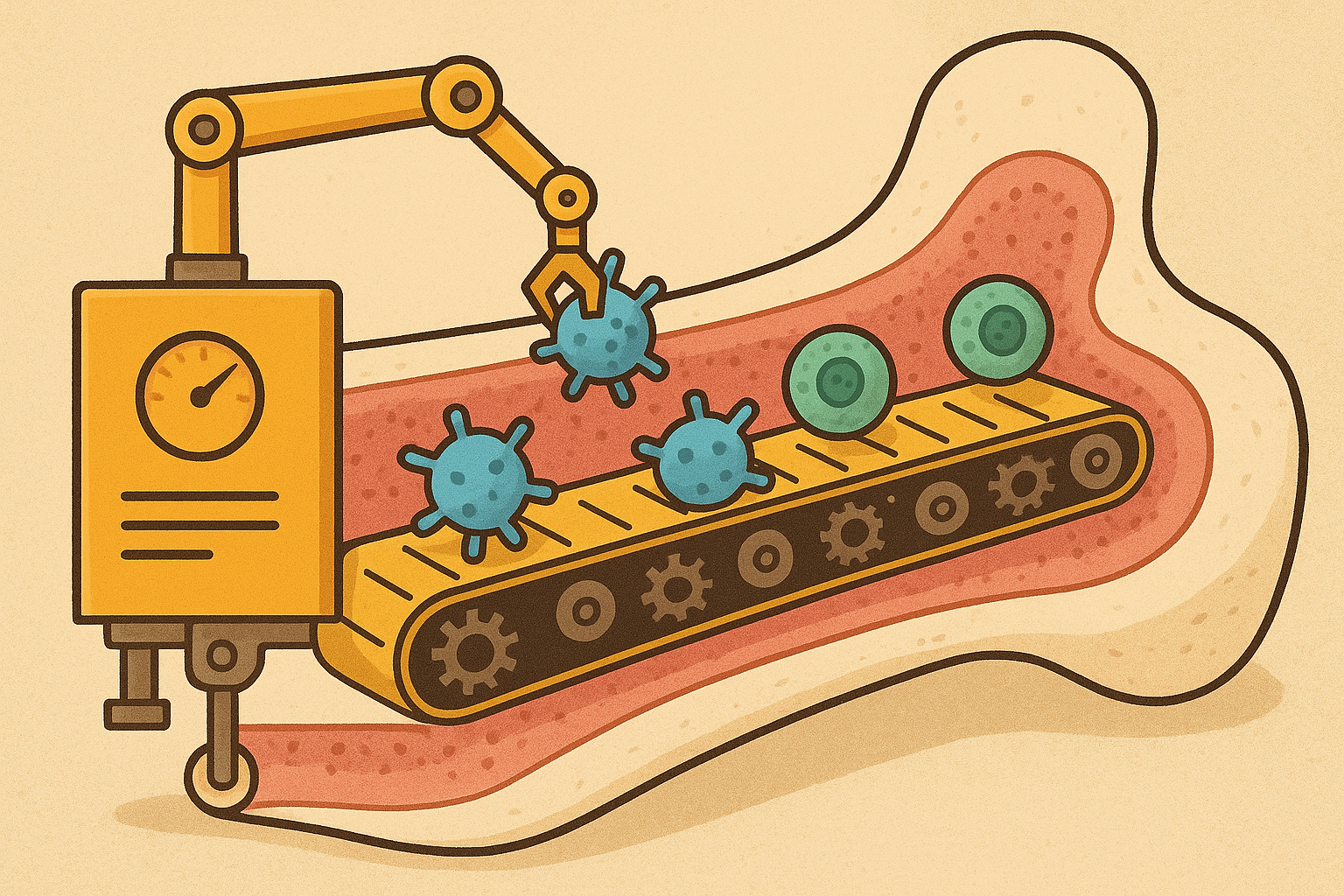
Inside your bones, there’s a hidden factory that never shuts down. Bone marrow hums like an assembly line, producing millions of immune cells every second. We notice its work, but without it, even a paper cut could be life-threatening. Stem cells in the marrow decide what’s needed: B cells to make antibodies, T cells to coordinate attacks, neutrophils to rush into infections. It’s a nonstop balancing act, and when the system falters, the body’s defenses collapse. Quietly, invisibly, your bone marrow is the busiest factory you’ll ever own.
Podcasts We Loved This Week
- Dr. Nammy Patel: Redefining Oral Health - The surprising Link Between Your Mouth, Disease & Longevity via LONGEVITY with Nathalie Niddam
- Endel for Focus: Study: High Intensity via Study via Endel
This second featured episode is less of a traditional podcast and more of a product. But I discovered this in Apple Podcasts this week, used it and liked it. Enjoy!
Products We Are Enjoying

Qualia Probiotic+ is the most complete gut health formula I’ve found. It eases bloating, supports digestion, and helps nutrients absorb better. With spore-form probiotics, pre- and postbiotics, and Akkermansia support, it goes beyond basics—helping rebalance your gut while also supporting mood, brain performance, and overall vitality in one scoop.
humanOS Catalog Feature of the Week

Fiber — from The Mediterranean Diet
This week, we'd like to highlight one of the lessons from our new-and-improved Mediterranean Diet course. This lesson delves into some of the surprising benefits of dietary fiber, particularly in the context of a traditional Mediterranean diet.
To Access:
- Log in to humanOS.
- See Courses in navigation on the left-hand side
- Click Mediterranean Diet
- Find lesson 7 - Fiber.
Also, you can search “Mediterranean Diet” in the search field after you’ve logged in.
Wishing you the best,